
Psychometric Properties of Malay Obsessive Compulsive Inventory-Revised: A Cross-sectional Study
Validation Malay OCI-R
Vol. 21 No. 2 : 2026 (749-761)

Abstract
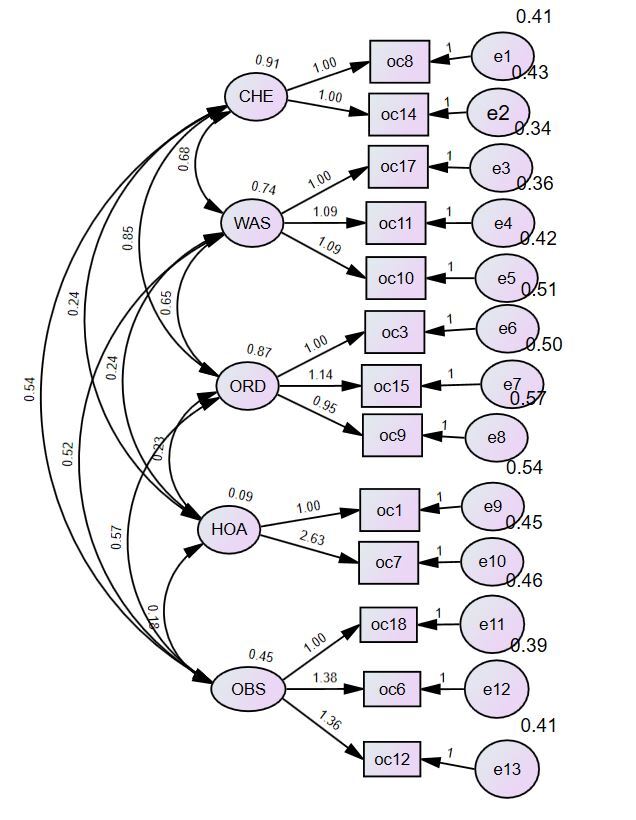
The Obsessive-Compulsive Inventory-Revised (OCI-R) is a valid and reliable instrument used to screen obsessive-compulsive disorder (OCD) symptoms. This scale has been translated into numerous languages, although not the Malay language. The aim of this study is to examine the reliability and validity of Malay-language OCI-R in a community population. The 18-item surveys were completed by 223 healthy people. The OCI-R English version was translated backward and forward to the Malay language. Prior to distributing the questionnaire to the participants, face validity was done. Exploratory factor analysis (EFA) and confirmatory factor analysis (CFA) were run to determine the psychometric qualities of the Malay language OCI-R. A total of 223 respondents mean aged of 33 (6.9) years, and 62% of respondents were female participated in this study. Based on EFA, the Malay language OCI-R showed high internal consistency and good convergent validity with a five-factor domain: "Washing", "Ordering", "Obsessions", "Checking" and "Hoarding". CFA analysis indicated an adequate fit index of (ꭓ2(160) = 4.24, root mean square error of approximation = 0.09, goodness of fit index = 0.89, adjusted goodness of fit index = 0.82, normed fit index = 0.91 and comparative fit index = 0.93) which supported a five-factor domain structure. The Malay OCI-R had a strong internal consistency, making it a credible and valid tool for identifying OCD symptoms in the general public. To improve the generalisability of these results, a larger study should be carried out with a bigger sample size and involving psychiatric patients.
Keywords :
Obsessive-compulsive disorder; OCI-R; reliability; validity,
Correspondance Address
shalisah@hctm.ukm.edu.my
References
Abramovitch, A., Abramowitz, J.S., McKay, D. 2021a. The OCI-4: An ultra-brief screening scale for obsessive-compulsive disorder. J Anxiety Disord 78: 102354. https://doi.org/10.1016/j.janxdis.2021.102354
Abramovitch, A., Abramowitz, J.S., McKay, D. 2021b. The OCI-12: A syndromally valid modification of the obsessive-compulsive inventory-revised. Psychiatry Res 298: 113808. https://doi.org/10.1016/j.psychres.2021.113808
Abramowitz, J.S., Huppert, J.D., Cohen, A.B., Tolin, D.F., Cahill, S.P. 2002. Religious obsessions and compulsions in a non-clinical sample: The Penn Inventory of Scrupulosity (PIOS). Behav Res Ther 40(7): 825-38. https://doi.org/10.1016/S0005-7967(01)00070-5
Aboujaoude, E., Holaway, R.M., Bhatia, R. 2024. Obsessive-compulsive and related disorders. In Study Guide to DSM-5-TR. Roberts LW, Louie AK, Edwards ML (eds.). Washington, DC: American Psychiatric Association Publishing; 75
Ahmad, N., Shariff, S.M. 2016. Supply chain management: Sertu cleansing for halal logisitics integrity. Procedia Economics and Finance 37: 418-25.
Angst, J., Gamma, A., Endrass, J., Goodwin, R., Ajdacic, V., Eich, D., Rössler, W. 2004. Obsessive-compulsive severity spectrum in the community: Prevalence, comorbidity, and course. Eur Arch Psychiatry Clin Neurosci 254(3): 156-64. https://doi.org/10.1007/s00406004-0459-4
Antony, M.M., Downie, F., Swinson, R.P. 1998. Diagnostic issues and epidemiology in obsessive-compulsive disorder. In Obsessivecompulsive disorder: Theory, research and treatment. Swinson RP, Antony MM, Rachman S, Richter MA, (eds). New York: The Guilford Press; 3-32.
Arifin, W.N., Yusoff, M.S.B. 2016. Confirmatory factor analysis of the Universiti Sains Malaysia emotional quotient inventory among medical students in Malaysia. Sage Open 6(2): 2158244016650240.
Aydin, A., Boysan, M., Kalafat, T., Selvi, Y., Beşiroğlu, L., Kagan, M. 2014. Validation of the Turkish version of the Obsessive-Compulsive InventoryRevised (OCI-R) in clinical and non-clinical samples. Noro Psikiyatr Ars 51(1): 15-22. https://doi.org/10.4274/npa.y6451
Ayonrinde, O.A., Stefatos, A., Miller, S., Richer, A., Nadkarni, P., She, J., Alghofaily, A., Mngoma, N. 2021. The salience and symbolism of numbers across cultural beliefs and practice. Int Rev Psych 33(1-2): 179-88.
Benito, K., Storch, E.A. 2011. Assessment of obsessive-compulsive disorder: Review and future directions. Expert Rev Neurother 11(2): 287-98. https://doi.org/10.1586/ern.10.195
Brown, T.A. 2015. Confirmatory factor analysis for applied research. New York: Guilford Press. Che Din, N., Mohd Nawi, L., Ghazali, S. E., Ahmad, M., Ibrahim, N., Said, Z., Amit, N., Subramaniam, P. 2019. Preliminary analysis of the factor structure, reliability and validity of an obsessive-compulsive disorder screening tool for use with adults in Malaysia. Int J Environ Res Public Health 16(23): 4763. https://doi.org/10.3390/ijerph16234763
Clark, L.A., Watson, D. 2016. Constructing validity: Basic issues in objective scale development. Psychol Assess 7(3): 309-19. Costello, A.B., Osborne, J. 2005. Best practices in exploratory factor analysis: Four recommendations for getting the most from your analysis. Pract Assess Res Eval 10(1): 7. https://doi.org/10.7275/jyj1-4868
Edwards, J.R., Bagozzi, R.P. 2000. On the nature and direction of relationships between constructs and measures. Psychol Methods 5(2): 155-74. https://doi.org/10.1037/1082-989X.5.2.155
Fitri Sarnin, E., Sharip, S., Badilla Idris, I., Mohd Hashim, S., Salwina Wan Ismail, W., Nazri Abdul Rahman, F., Kamal, N., Abdullah Mahady, Z., Baharim, N., Hamlett, G.E., Foa, E.B. 2022. Psychometric properties of Malay Obsessive-compulsive Inventory-child Version (OCI-CV) in Malaysian perspectives. Scand J Child Adolesc Psychiatr Psychol 10(1): 114-22. https://doi.org/10.2478/sjcapp-2022-0012
Foa, E.B., Huppert, J.D., Leiberg, S., Langner, R., Kichic, R., Hajcak, G., Salkovskis, P.M. 2002. The Obsessive-Compulsive Inventory: Development and validation of a short version. Psychol Assess 14(4): 485-96. https://doi.org/10.1037/1040-3590.14.4.485
Foa, E.B., Kozak, M.J., Salkovskis, P.M., Coles, M.E., Amir, N. 1998. The validation of a new obsessive–compulsive disorder scale: The Obsessive–Compulsive Inventory. Psychol Assess 10(3): 206-14. https://doi.org/10.1037/1040-3590.10.3.206
Goetz, C., Coste, J., Lemetayer, F., Rat, A., Montel, S., Recchia, S., Debouverie,M., Pouchot,J., Spitz, E., Guillemin, F. 2013. Item reduction based on rigorous methodological guidelines is necessary to maintain validity when shortening composite measurement scales. J Clin Epidemiol, 66(7): 710-8. https://doi.org/10.1016/j.jclinepi.2012.12.015
Gong, H., Nederpel, T.M.H., Lin, G., Zhang, Y., Yang, Y., Li, B., Luo, X., Fang, F., Li, B., Zhan, S. 2020. The Obsessive-Compulsive Inventory-Revised: Replication of the psychometric properties in China. Bull Menninger Clin 84(Supplement A), 34-47. https://doi.org/10.1521/bumc.2020.84.suppA.34
Goodman, W.K., Price, L.H., Rasmussen, S.A., Mazure, C.M., Fleischmann, RL., Hill, C.L., Heninger, G.R., Charney, D.S. 1989. The Yale-Brown obsessive compulsive scale: I. Development, use, and reliability. Arch Gen Psych 46(11): 1006-11. https://doi.org/10.1001/archpsyc.1989.01810110048007
Goretzko, D., Siemund, K., Sterner, P. 2024. Evaluating model fit of measurement models in confirmatory factor analysis. Educ Psychol Meas 84(1): 123-144.
Hajcak, G., Huppert, J.D., Simons, R.F., Foa, E.B. 2004. Psychometric properties of the OCI-R in a college sample. Behav Res Ther 42(1): 115-23. https://doi.org/10.1016/j.brat.2003.08.002
Hawkins, M., Cheng, C., Elsworth, G.R., Osborne, R.H. 2020. Translation method is validity evidence for construct equivalence: Analysis of secondary data routinely collected during translations of the Health Literacy Questionnaire (HLQ). BMC Med Res Methodol 20(1): 130. https://doi.org/10.1186/s12874-020-00962-8
Hirschtritt, M.E., Bloch, M.H., Mathews, C.A. 2017. Obsessive compulsive disorder: Advances in diagnosis and treatment. JAMA 317(13): 135867. https://doi.org/10.1001/jama.2017.2200
Hon, S.K.H., Siu, B.W.M., Cheng, C.W., Wong, W.C. W., Foa, E.B. 2019. Validation of the Chinese version of obsessive-compulsive inventoryrevised. East Asian Arch Psych 29(4): 103-11. https://doi.org/10.12809/eaap1832
Khaiyom, J.H.A., Mukhtar, F., Oei, T.P.S. 2021. Anxiety disorders In Malaysia from 2005 to 2015: A scoping review of their prevalence rates, associated factors, and predictors. J Health Transl Med 24(2): 31-47. Knekta, E., Runyon, C., Eddy, S. 2019. One size doesn’t fit all: Using factor analysis to gather validity evidence when using surveys in your research. CBE—Life Sci Educ 18(1): 1-17. https://doi.org/10.1187/cbe.18-04-0064
Lafave, M.R., Hiemstra, L., Kerslake, S. 2016. Factor analysis and item reduction of the Banff Patella Instability Instrument (BPII) Introduction of BPII 2.0. Am J Sports Med 44(8): 2081-6. https://doi.org/10.1177/0363546516644605
Lewin, A.B., De Nadai, A.S., Park, J., Goodman, W.K., Murphy, T.K., Storch, E.A. 2011. Refining clinical judgment of treatment outcome in obsessive–compulsive disorder. Psych Res 185(3): 394-401. https://doi.org/10.1016/j.psychres.2010.08.021
Lim, J.S., Kim, S.J., Jeon, W.T., Cha, K.R., Park, J.H., Kim, C.H. 2008. Reliability and validity of the Korean version of Obsessive-Compulsive Inventory-Revised in a non-clinical sample. Yonsei Med J 49(6): 909-16. https://doi.org/10.3349/ymj.2008.49.6.909
Molnar, F.J., Benjamin, S., Hawkins, S.A., Briscoe, M., Ehsan, S. 2020. One size does not fit all: Choosing practical cognitive screening tools for your practice. J Am Geriatr Soc 68(10): 2207-13. Mowrer, O. 1960. Learning theory and behavior. New York: John Wiley & Sons.Nelson, E.A., Abramowitz, J.S., Whiteside, S.P., Deacon, B. J. 2006. Scrupulosity in patients with obsessive–compulsive disorder: Relationship to clinical and cognitive phenomena. J Anxiety Disord 20(8): 1071-86. https://doi.org/10.1016/j.janxdis.2006.02.001
O’Connor, K., Freeston, M.H., Delorme, M.E., Aardema, F., Polman, A., Careau, Y., Grenier, S. 2012. Covert neutralization in the treatment of OCD with overt compulsions. J Obsessive Compuls Relat Disord 1(4): 274-82. https://doi.org/10.1016/j.jocrd.2012.06.003
Peng, Z.W., Yang, W.H., Miao, G.D., Jing, J., Chan, R.C. 2011. The Chinese version of the obsessive-compulsive inventory-revised scale: Replication and extension to non-clinical and clinical individuals with OCD symptoms. BMC Psychiatry, 11: 129. https://doi.org/10.1186/1471244X-11-129
Polit, D.F., Beck, C.T. 2010. Generalization in quantitative and qualitative research: myths and strategies. Int J Nurs Stud 47(11): 1451-8. https://doi.org/10.1016/j.ijnurstu.2010.06.004
Rapp, A.M., Bergman, R.L., Piacentini, J., McGuire, J.F. 2016. Evidence-based assessment of obsessive-compulsive disorder. J Cent Nerv Syst Dis 8: 13-29. https://doi.org/10.4137/JCNSD.S38359
Raubenheimer, J.E. 2004. An item selection procedure to maximize scale reliability and validity. SA Journal of Industrial Psychology, 30(4): 59-64. https://doi.org/10.4102/sajip.v30i4.168
Senter, M.S., Patel, S.R., Dixon, L.B., Myers, R.W., Simpson, H.B. 2021. Defining and addressing gaps in care for obsessive-compulsive disorder in the United States. Psychiatr Serv 72(7): 78493. https://doi.org/10.1176/appi.ps.202000296
Schermelleh-Engel, K., Moosbrugger, H., Müller, H. 2003. Evaluating the fit of structural equation models: Tests of significance and descriptive goodness-of-fit measures. Methods of Psychol Res Online 8(2): 23-74. Schober, P., Boer, C., Schwarte, L.A. 2018. Correlation coefficients: Appropriate use and interpretation. Anesth Analg 126(5): 1763-8. https://doi. org/10.1213/ANE.0000000000002864 Schreiber, J.B., Nora, A., Stage, F.K., Barlow, E.A., King, J. 2006. Reporting structural equation modeling and confirmatory factor analysis results: A review. J Educ Res 99(6): 323-38. https://doi.org/10.3200/JOER.99.6.323-338 Senanayake, B., Rajasuriya, M., Suraweera, C., Arambepola, C. 2018. How valid is ObsessiveCompulsive Inventory-Revised Scale among Sri Lankan adults? Indian J Psychiatr 60(3): 318-23. https://doi.org/10.4103/psychiatry. IndianJPsychiatry_171_18 Sousa, V.D., Zauszniewski, J.A., Jaber, A.F. 2010. Confirmatory factor analysis of the depressive cognition scale. Arch Psychiatr Nurs 24(6): 397407. https://doi.org/10.1016/j.apnu.2010.03.004 Souza, F.P., Foa, E.B., Meyer, E., Niederauer, K.G., Cordioli, A.V. 2011. Psychometric properties of the Brazilian Portuguese version of the Obsessive-Compulsive Inventory - Revised (OCI-R). Braz J Psychiatry 33(2): 137-43. https:// doi.org/10.1590/s1516-44462011000200008 Souza, F.P., Foa, E.B., Meyer, E., Niederauer, K.G., Raffin, A.L., Cordioli, A.V. 2008. Obsessivecompulsive inventory and obsessivecompulsive inventory-revised scales: translation into brazilian portuguese and cross-cultural adaptation. Braz J Psychiatry 30(1): 42-6. https:// doi.org/10.1590/s1516-44462006005000065 Storch, E.A., Rasmussen, S.A., Price, L.H., Larson, M.J., Murphy, T.K., Goodman, W.K. 2010. Development and psychometric evaluation of the Yale–Brown obsessive-compulsive scaleSecond Edition. Psychol Assess 22(2): 223-32. https://doi.org/10.1037/a0018492 Tabachnick, B.G., Fidell, L.S. 2013. Using multivariate statistics. Boston, MA: Pearson Tavakol, M., Dennick, R. 2011. Making sense of Cronbach’s alpha. Int J Med Educ 2: 53-5. https://doi.org/10.5116/ijme.4dfb.8dfd Tek, C., Ulug, B. 2001. Religiosity and religious obsessions in obsessive–compulsive disorder. Psychiatry Res 104(2), 99-108. https://doi. org/10.1016/S0165-1781(01)00310-9 Tuleja, E.A., Beamer, L., Shum, C., Chan, E.K.Y. 2011. Designing and developing questionnaires for translation tutorial. IEEE Trans Prof Commun 54(4): 392-405. https://doi.org/10.1109/ TPC.2011.2172834 van den Hout, M., Kindt, M., Weiland, T., Peters, M. 2002. Instructed neutralization, spontaneous neutralization and prevented neutralization after an obsession-like thought. J Behav Ther Exp Psychiatry 33(3-4): 177-89. https://doi. org/10.1016/s0005-7916(02)00048-4 Varela Cunha, G., Silva Moreira, P., Machado Sousa, M., Castanho, T., Picó-Pérez, M., Ferreira, S., Morgado, P. 2023. The obsessive-compulsive inventory-revised (OCI-R): Translation and validation of the European Portuguese Version. Acta Med Port 36(3): 174-82. https://doi. org/10.20344/amp.16452 Veale, D. 2004. Psychopathology of obsessivecompulsive disorder. Psychiatry 3(6): 65-8. https://doi.org/10.1383/psyt.3.6.65.38213 Vogt, G.S., Avendaño-Ortega, M., Schneider, S. C., Goodman, W.K., Storch, E.A. 2022. Optimizing obsessive-compulsive symptom measurement with the Yale-Brown obsessivecompulsive scales-Second Edition. J Psychiatr Pract 28(4): 294-309. https://doi.org/10.1097/ pra.0000000000000640 Wirth, R.J., Edwards, M.C. 2007. Item factor analysis: Current approaches and future directions. Psychol Methods 12(1): 58-79. https://doi. org/10.1037/1082-989X.12.1.58 Wong, L.P., Alias, H., Md Fuzi, A.A., Omar, I.S., Mohamad Nor, A., Tan, M.P., Baranovich, D.L., Saari, C.Z.,Hamzah, S.H.,Cheong, K.W., Poon, C.H., Ramoo, V., Che, C.C., Myint, K., Zainuddin, S., Chung, I. 2021. Escalating progression of mental health disorders during the COVID-19 pandemic: Evidence from a nationwide survey. PLoS One 16(3): e0248916. https://doi.org/10.1371/journal.pone.0248916 Woo, C.W., Kwon, S., Lim, Y., Shin, M.J. 2010. The Obsessive-compulsive inventory-revised (OCI-R): Psychometric properties of the Korean version and the order, gender and cultural effects. J Behav Ther Exp Psychiatry 41(3): 2207. https://doi.org/10.1016/j.jbtep.2010.01.006 Yu, D.S., Lee, D.T., Woo, J. 2004. Issues and challenges of instrument translation. West J Nurs Res 26(3): 307-20. https://doi. org/10.1177/0193945903260554 Zauszniewski, J.A., Bekhet, A.K. 2012. Screening measure for early detection of depressive symptoms: the depressive cognition scale. West J Nurs Res 34(2): 230-44. https://doi. org/10.1177/019394591039673


