A Pilot Study on Self-Care Module in Preventing Mental Health Risks for Youth
Self-Care Module for Mentally Healthy Youth
Vol. 21 No. 2 : 2026 (988-1009)

Abstract
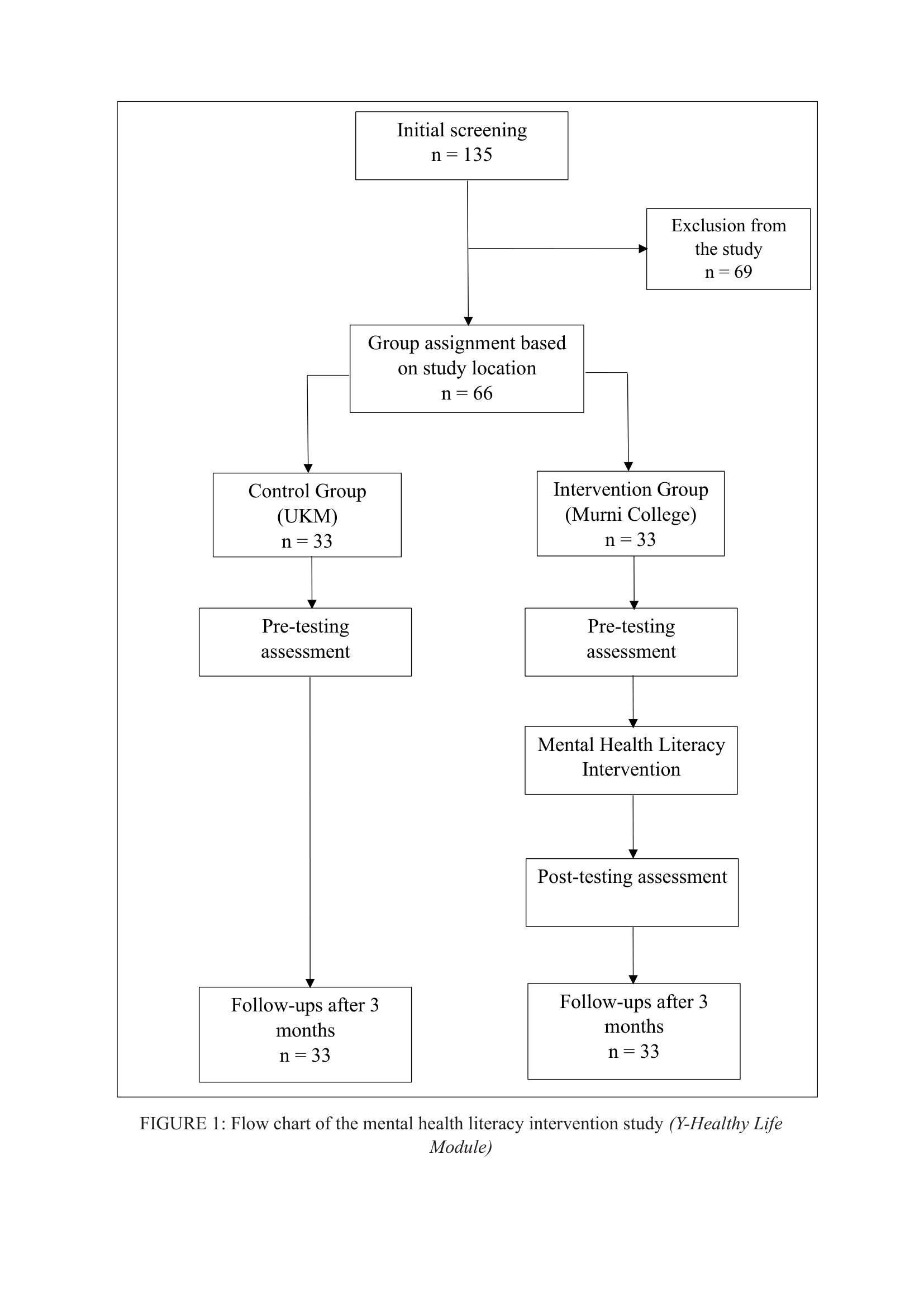
Youth are a national asset with growing potential to develop the country through academic achievement and career skills. They are facing post-pandemic challenges resulting in life stress, resilience and declining personal health functions. It has an impact on public and social health due to school dropout, suicide attempts, vandalism, bullying and the use of illegal substances. Mental health problems continue to increase at an alarming rate despite various initiatives that have been implemented. There is a lack of accessible publications regarding strategic interventions as best practices. This study aimed to assess the feasibility of a newly developed self-care module intervention for promoting mental health. A sequential exploratory mixed methods study was used, combining quantitative and qualitative analyses focusing on young people in higher education institutions aged 18-21 years. The control group (n = 33) and intervention group (n = 33) were assessed for feasibility and 3-month follow-up. Intervention modules in the form of flip books and digital applications were developed to improve youth self-care in preventing stress, anxiety, depression, and measuring youth well-being and quality of life. The study found significant differences for all Dependent Variables (Barriers to Mental Health Services Scale-Revised, Youth Quality of Life-Short Form, Depression, Anxiety and Stress Scale-21, Brief-COPE and Y-Healthy Life Module Quiz) with a p < 0.001 using both methods (printed modules and digital applications) at pre- and post-intervention. In conclusion, self-education approaches in promoting mental health among youth are feasible to implement.
Keywords :
Anxiety; depression; intervention; mental health; stress; youth,
Correspondance Address
rosnah.sutan@ukm.edu.my
References
Benton, D.T., Boyd, C.R., Njoroge, M.F.W. 2021. Addressing the global crisis of child and adolescent mental health. JAMA Pediatr 175(11): 1108-10. https://doi.org/10.1001/jamapediatrics.2021.2479
Cohen, J. 1988. Statistical Power Analysis for the Behavioral Sciences. 2nd ed. Hillsdale, NJ: Lawrence Erlbaum Associates.
Das, R., Hasan, M.R., Daria, S., Islam, M.R. 2020. Impact of COVID-19 pandemic on mental health among general Bangladeshi population: A cross-sectional study. BMJ Open 11(4): e045727. https://doi.org/10.1136/bmjopen-2020-045727
Daviu, N., Bruchas, M.R., Moghaddam, B., Sandi, C., Beyeler, A. 2019. Neurobiological links between stress and anxiety. Neurobiol Stress 11: 100191. https://doi.org/10.1016/j.ynstr.2019.100191
Hamdani, S.U., Huma, Z.E., Malik, A., Tamizuddin-Nizami, A., ul Baneen, U., Suleman, N., Javed, H., Wang, D., van Ommeren, M., Mazhar, S., Khan, S.A., Minhas, F.A., Rahman, A. 2022. Improving psychosocial distress for young adolescents in rural schools of Pakistan: Study protocol of a cluster randomised controlled trial. BMJ Open 12: e063607. https://doi.org/10.1136/bmjopen-2022-063607
Harrer, M., Apolinário-Hagen, J., Fritsche, L., Druge, M., Krings, L., Beck, K., Salewski, C., Zarski, A.C., Lehr, D., Baumeister, H., Ebert, D.D. 2019. Internet and app-based stress intervention for distance-learning students with depressive symptoms: Protocol of a randomized controlled trial. Front Psychiatry 10: 361. https://doi.org/10.3389/fpsyt.2019.00361
Harrer, M., Apolinário-Hagen, J., Fritsche, L., Salewski, C., Zarski, A.C., Lehr, D., Baumeister, H., Cuijpers, P., Ebert, D.D. 2021. Effect of an internet- and app-based stress intervention compared to online psychoeducation in university students with depressive symptoms: Results of a randomized controlled trial. Internet Interv 24: 100374. https://doi.org/10.1016/j.invent.2021.100374
Huberty, J., Green, J., Glissmann, C., Larkey, L., Puzia, M., Lee, C. 2019. Efficacy of the mindfulness meditation mobile app “Calm” to reduce stress among college students: Randomized controlled trial. JMIR Mhealth Uhealth 7(6): e14273. https://doi.org/10.2196/14273
Ibrahim, N., Mohd Safien, A., Siau, C.S., Shahar, S. 2020. The effectiveness of a depression literacy program on stigma and mental help-seeking among adolescents in Malaysia: A control group study with 3-month follow-up. Health Serv Res Manag Epidemiol 7: 1-10. https://doi.org/10.1177/0046958020902332
Institute for Public Health. 2022. Technical Report: National Health and Morbidity Survey (NHMS) 2022: Adolescent Health Survey, Malaysia. National Institutes of Health, Ministry of Health Malaysia. https://iku.nih.gov.my/images/nhms2022/Report_Malaysia_nhms_ahs_2022.pdf [Accessed on 24 July 2026].
Lee, J. 2020. Mental health effects of school closures during COVID-19. Lancet Child Adolesc Health 4(6): 421. https://doi.org/10.1016/S2352-4642(20)30109-7
Lindow, J.C., Hughes, J.L., South, C., Minhajuddin, A., Gutierrez, L., Bannister, E., Trivedi, M.H., Byerly, M.J. 2020. The Youth Aware of Mental Health intervention: Impact on help-seeking, mental health knowledge, and stigma in US adolescents. J Adolesc Health 67(1): 101-7. https://doi.org/10.1016/j.jadohealth.2020.01.006
Mansor, J., Abu Rahim, R.A.M. 2020. Cabaran dan Strategi Pasca-Pandemik untuk Belia. Khazanah Research Institute (KRI) Discussion Paper. https://www.krinstitute.org/publications/cabaran-dan-strategi-pasca-pandemik-untuk-belia [Accessed on 13 April 2020].
Michelson, D., Malik, K., Parikh, R., Weiss, A.H., Doyle, M.A., Bhat, B., Sahu, R., Chilhate, B., Mathur, S., Krishna, M., Sharma, R., Sudhir, P., King, M., Cuijpers, P., Chorpita, B., Fairburn, C.G., Patel, V. 2020. Effectiveness of a brief lay counsellor-delivered, problem-solving intervention for adolescent mental health problems in urban, low-income schools in India: A randomised controlled trial. Lancet Child Adolesc Health 4(8): 571-82. https://doi.org/10.1016/S2352-4642(20)30173-5
Mindu, T., Mutero, I.T., Ngcobo, B.W., Musesengwa, R., Chimbari, J.M. 2023. Digital mental health interventions for young people in rural South Africa: Prospects and challenges for implementation. Int J Environ Res Public Health 20(2): 1453. https://doi.org/10.3390/ijerph20021453
Musa, R., Fadzil, M.A., Zain, Z. 2007. Translation, validation and psychometric properties of Bahasa Malaysia version of the Depression Anxiety and Stress Scales (DASS). ASEAN J Psychiatry 8: 82-9.
Newbold, A., Warren, F.C., Taylor, R.S., Hulme, C., Burnett, S., Aas, B., Botella, C., Burkhardt, F., Ehring, T., Fontaine, J.R.J., et al. 2020. Promotion of mental health in young adults via mobile phone app: Study protocol of the ECoWeB (Emotional Competence for Well-Being in Young Adults) cohort multiple randomised trials. BMC Psychiatry 20(1): 458. https://doi.org/10.1186/s12888-020-02857-w
Patrick, D.L., Edwards, T.C., Topolski, T.D. 2002. Adolescent quality of life, part II: Initial validation of a new instrument. J Adolesc 25(3): 287-300. https://doi.org/10.1006/jado.2002.0471
Pepin, R., Segal, D.L., Klebe, K.J., Coolidge, F.L., Krakowiak, K.M., Bartels, S.J. 2015. The barriers to mental health services scale revised: Psychometric analysis among older adults. Ment Health Prev 3(4): 178-84. https://doi.org/10.1016/j.mhp.2015.09.001
Perveen, A., Hamzah, H., Othman, A., Ramlee, F. 2020. Prevalence of anxiety, stress, depression among Malaysian adults during COVID-19 pandemic movement control order. Indian J Community Health 32(3): 579-81. https://doi.org/10.47203/IJCH.2020.v32i03.020
Rahim, U. 2013. IBM SPSS Statistics for Windows. https://www.ibm.com/products/spss [Accessed on 2 September 2013].
Razali, A.S. 2021. 1,099 bunuh diri sejak 2020 hingga Mei 2021. Berita Harian. https://www.bharian.com.my/berita/nasional/2021/07/834248/1099-bunuh-diri-sejak-2020-hingga-mei-2021 [Accessed on 1 July 2021].
Roslan, S. 2021. Kes bunuh diri meningkat 143 peratus. Berita Harian. https://www.bharian.com.my/berita/nasional/2021/09/862128/kes-bunuh-diri-meningkat-143-peratus [Accessed on 10 September 2021].
Shahruddin, A.S., Saseedaran, P., Salleh, D.A., Azmi, A.A.C., Alfaisal, M.I.H.N., Fuad, F.D.M., AlZurfi, N.M.B., Abdullah, R.M. 2016. Prevalence and risk factors of stress, anxiety and depression among house officers in Kota Kinabalu, Sabah. Educ Med J 8(1): 31-40. https://doi.org/10.5959/eimj.v8i1.398
Sundarasen, S., Chinna, K., Kamaluddin, K., Nurunnabi, M., Baloch, M.G., Khoshaim, B.H., Hossain, A.F.S., Sukayt, A. 2020. Psychological impact of COVID-19 and lockdown among university students in Malaysia: Implications and policy recommendations. Int J Environ Res Public Health 17(17): 6206. https://doi.org/10.3390/ijerph17176206
Taggart, D., Rouf, K., Hisham, I.B.I., Duckworth, L., Sweeney, A. 2021. Trauma, mental health and the COVID-19 crisis: Are we really all in it together? J Ment Health 30(4): 401-4. https://doi.org/10.1080/09638237.2021.1875415
Tay, J.L., Goh, Y.S.S., Sim, K., Klainin-Yobas, P. 2022. Impact of the HOPE intervention on mental health literacy, psychological well-being and stress levels amongst university undergraduates: A randomized controlled trial. Int J Environ Res Public Health 19(15): 9772. https://doi.org/10.3390/ijerph19159772
Thunstrom, L., Newbold, S.C., Finnoff, D., Ashworth, M., Shogren, J.F. 2020. The benefits and costs of using social distancing to flatten the curve for COVID-19. J Benefit Cost Anal 11(2): 179-95. https://doi.org/10.1017/bca.2020.12
Tornivuori, A., Kronström, K., Aromaa, M., Salanterä, S., Karukivi, M. 2023. Accessible mental wellbeing intervention for adolescents in school settings: A single-group intervention study using a pretest-post-test design. Child Adolesc Psychiatry Ment Health 17(1): 28. https://doi.org/10.1186/s13034-023-00576-0
UN Refugee Agency. 2021. Strengthening Mental Health and Psychosocial Support in 2021. UNHCR. https://www.unhcr.org/media/strengthening-mental-health-and-psychosocial-support-2021-pdf [Accessed on February 2021].
United Nations Children’s Fund. 2020. Impact of COVID-19 on Children and Families in Latin America and the Caribbean. UNICEF. https://www.unicef.org/lac/media/14381/file/UNICEF_LACRO_COVID19_impact.pdf [Accessed on July 2020].
Yusoff, M.S.B. 2019. ABC of content validation and content validity index calculation. Educ Med J 11(2): 49-54. https://doi.org/10.21315/eimj2019.11.2.6
Zainudeen, Z.T., Abd Hamid, I.J., Azizuddin, M.N.A., Abu Bakar, F.F., Sany, S., Zolkepli, I.A., Mangantig, E. 2021. Psychosocial impact of COVID-19 pandemic on Malaysian families: A cross-sectional study. BMJ Open 11(8): e050523. https://doi.org/10.1136/bmjopen-2021-050523
Zulkiply, S.H., Abdul Manaf, R., Dahlan, R., Dapari, R. 2023. Effect of ‘Kuat’, a theory- and web-based health education intervention, on mental health literacy among university students: A study protocol. PLoS One 18(3): e0283747. https://doi.org/10.1371/journal.pone.0283747