Linguistic Validation and Adaptation of a Malay Language Questionnaire to Measure Knowledge, Attitude and Behaviour Regarding Toothpaste Use and Toothbrushing for 12-Year-Old Children
Questionnaire on Toothpaste and Toothbrushing
Vol. 21 No. 2 : 2026 (781-798)

Abstract
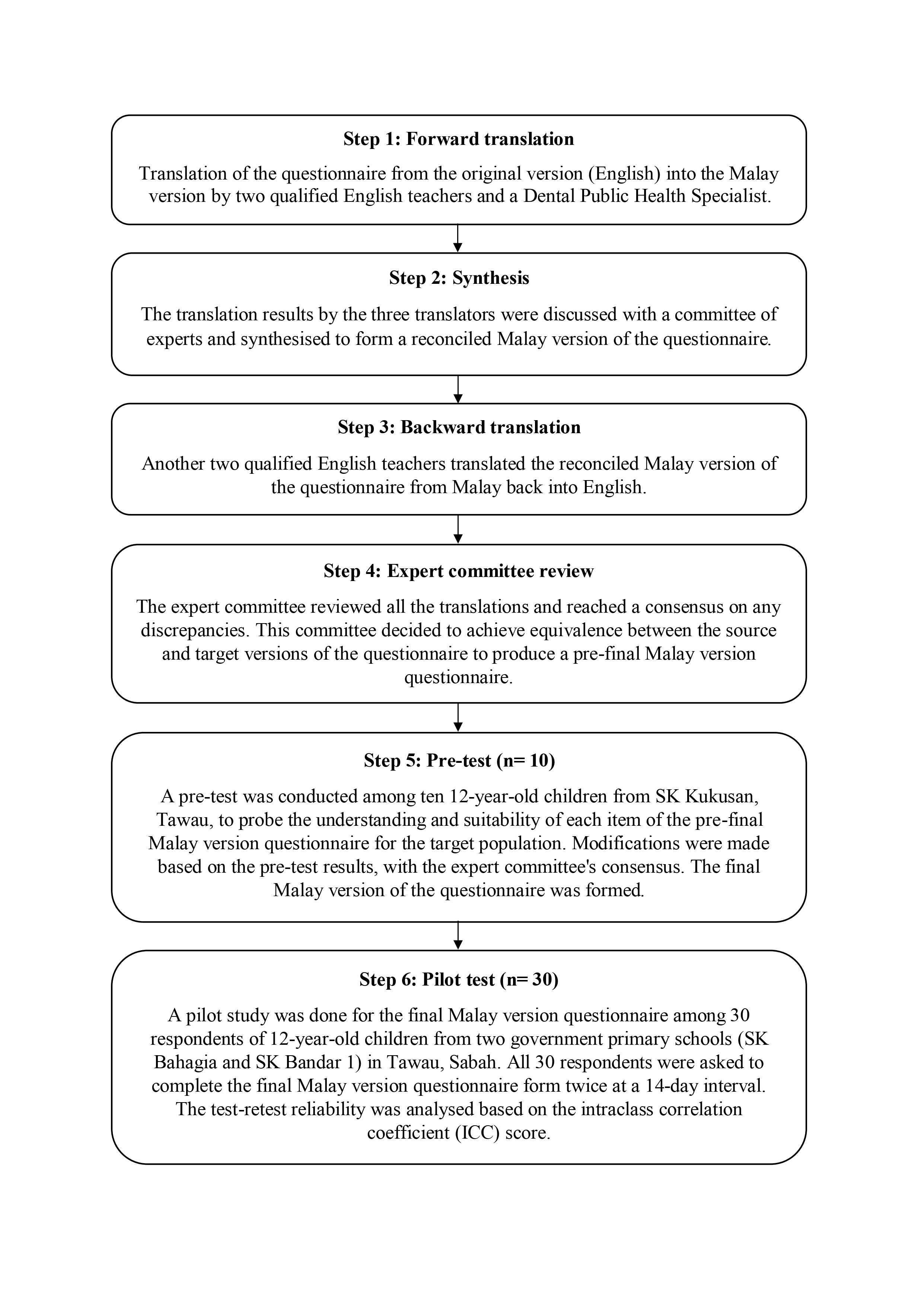
Knowledge, attitude and behaviour towards toothpaste use and toothbrushing are contributing factors for maintaining good oral health. This study was conducted to translate and adapt a questionnaire on the knowledge, attitude and behaviour of toothpaste use and toothbrushing for 12-year-old Malaysian children. The original questionnaire in English that assesses knowledge, attitude and behaviour on toothpaste use and toothbrushing was used in this study. The questionnaire translation process involves forward translation, backward translation and consolidation to establish the pre-final Malay version questionnaire. A pre-test using the pre-final Malay version questionnaire was conducted among 10 participants of 12-year-old children in Tawau, Sabah. The expert committee discussed and reviewed the pre-test results to produce the final Malay version questionnaire. A pilot test for the test-retest reliability using the final Malay version questionnaire was then conducted among 30 respondents of 12-year-old children in Tawau. The test-retest reliability was analysed based on the intraclass correlation coefficient (ICC) score. The Malay version questionnaire consisted of knowledge domain (3 items), attitude domain (5 items) and behaviour domain (16 items). The Malay version questionnaire semantic, experiential and conceptual aspects achieved the same equivalence as in the original questionnaire. The linguistic and face validity issues were successfully resolved. The test-retest reliability results of the knowledge domain (0.836), attitude domain (0.826) and behaviour domain (0.864) achieved an excellent ICC score. The Malay version of the questionnaire has been translated and adapted for local use to assess knowledge, attitude and behaviour of toothpaste use and toothbrushing.
Keywords :
Children; questionnaires; toothbrushing; toothpastes; translations,
Correspondance Address
ruhaya@usm.my
References
Ahmad, V.N., Hazman, N., Razali, A.S., Rasdi, Z., Zulkapli, R. 2019. Practices, attitudes, and awareness of suburban adolescence schoolchildren towards oral hygiene: School- based survey. J Health Transl Med 22(2): 56-63. https://doi.org/10.22452/jummec.vol22no2.9
Al-Samadani, K.H., Ahmad, M.S., Bakeer, H.A., Elanbya, M.O.G. 2017. Oral health knowledge and practice among 9 to 12-year-old schoolchildren in the region of Madinah, Saudi Arabia, and its impact on the prevalence of dental caries. European J Gen Dent 6(1): 54-8. https://doi.org/10.4103/2278-9626.198615
Alshloul, M.N. 2021. Oral health knowledge, attitude, and practice among school children in Abha- Saudi Arabia. J Sch Nurs 39(4): 295-304. https://doi.org/10.1177/10598405211012981
American Academy of Pediatric Dentistry. 2024. Fluoride Therapy. In The Reference Manual of Pediatric Dentistry. Chicago: American Academy of Pediatric Dentistry; 351-7.
Anis, J.W., Hamid, M.H.A., Nor, N.M., Nor, N.A. M. 2019. Fluoride content, cost and labelling of commercially available toothpastes in Malaysia. Arch Orofac Sci 14(2): 113-31. https://doi.org/10.21315/aos2019.14.2.377
Baghlaf, K., Muirhead, V., Moynihan, P., WestonPrice, S., Pine, C. 2018. Free sugars consumption around bedtime and dental caries in children: A systematic review. JDR Clin Trans Res 3(2): 11829. https://doi.org/10.1177/2380084417749215
Baumgartner, C.S., Wang, N.J., Wigen, T.I. 2022. Oral health behaviours in 12-year-old. Association with caries and characteristics of the children? Acta Odontol Scand 80(1): 15-20. https://doi.org/10.1080/00016357.2021.1933173
Beaton, D.E., Bombardier, C., Guillemin, F., Ferraz, M.B. 2000. Guidelines for the process of crosscultural adaptation of self-report measures. Spine (Phila Pa 1976) 25(24): 3186-91. https://doi.org/10.1097/00007632-200012150-00014
Bettie, N.F., Ramachandiran, H., Anand, V., Sathiamurthy, A., Sekaran, P. 2015. Tools for evaluating oral health and quality of life. J Pharm Bioallied Sci 7(Suppl 2): 414-9. https://doi.org/10.4103/0975-7406.163473
Bujang, M.A., Omar, E.D., Foo, D.H.P., Hon, Y.K. 2024. Sample size determination for conducting a pilot study to assess reliability of a questionnaire. Restor Dent Endod 49(1): e3. https://doi.org/10.5395/rde.2024.49.e3
Chin, Y.J., Mani, S.A., Doss, J.G., Musa, S., Danaee, M. 2024. Cross-cultural adaptation and psychometric properties of the Malay version of parenting and child tooth brushing assessment (M-PACTA). BMC Oral Health 24(1): 949. https://doi.org/10.1186/s12903-024-04701-z
Connell, J., Carlton, J., Grundy, A., Taylor Buck, E., Keetharuth, A.D., Ricketts, T., Barkham, M., Robotham, D., Rose, D., Brazier, J. 2018. The importance of content and face validity in instrument development: Lessons learnt from service users when developing the Recovering Quality of Life measure (ReQoL). Qual Life Res 27: 1893-1902. https://doi.org/10.1007/s11136018-1847-y
Creeth, J., Bosma, M.L., Govier, K. 2013. How much is a ‘pea-sized amount’? A study of dentifrice dosing by parents in three countries. Int Dent J 63: 25-30. https://doi.org/10.1111/idj.12076
Cruchinho, P., López-Franco, M.D., Capelas, M.L., Almeida, S., Bennett, P.M., Miranda, S.M., Teixeira, G., Nunes, E., Lucas, P., Gaspar, F. 2024. Translation, cross-cultural adaptation, and validation of measurement instruments: A practical guideline for novice researchers. J Multidiscip Healthc 17: 2701-28. https://doi.org/10.2147/JMDH.S419714
Cui, Z., Wang, W., Si, Y., Wang, X., Feng, X., Tai, B., Hu, D., Lin, H., Wang, B., Wang, C., Zheng, S., Liu, X., Rong, W., Wang, W. 2023. Tooth brushing with fluoridated toothpaste and associated factors among Chinese adolescents: A nationwide cross-sectional study. BMC Oral Health 23(1): 765. https://doi.org/10.1186/s12903-023-03506-w
Deinzer, R., Cordes, O., Weber, J., Hassebrauck, L., Weik, U., Krämer, N., Pieper, K., MargrafStiksrud, J. 2019. Toothbrushing behaviour in children – An observational study of toothbrushing performance in 12-year-old. BMC Oral Health 19(1): 68. https://doi.org/10.1186/s12903-019-0755-z
Dolah, S., Eusufzai, S.Z., Alam, M.K., Ahmad, W. M.A.W. 2020. Factors influencing oral healthrelated quality of life among preschool children in district of Kota Bharu, Malaysia: A crosssectional study. Pesqui Bras Odontopediatria Clin Integr 20: 1-10. https://doi.org/10.1590/pboci.2020.008
Efstathiou, G. 2019. Translation, adaptation and validation process of research instruments. In Individualized Care. Eds Suhonen R, Stolt M, Papastavrou E. Springer International Publishing: 65-78. https://doi.org/10.1007/9783-319-89899-5_7
Eid, S.A., Khattab, N.M.A., Elheeny, A.A.H. 2020. Untreated dental caries prevalence and impact on the quality of life among 11 to 14-year-old Egyptian schoolchildren: A cross-sectional study. BMC Oral Health 20(1): 83. https://doi.org/10.1186/s12903-020-01077-8
Eidenhardt, Z., Busse, S., Margraf-Stiksrud, J., Deinzer, R. 2022. Patients’ awareness regarding the quality of their oral hygiene: Development and validation of a new measurement instrument. BMC Oral Health 22(1): 629. https://doi.org/10.1186/s12903-022-02659-4
Epstein, J., Santo, R.M., Guillemin, F. 2015. A review of guidelines for cross-cultural adaptation of questionnaires could not bring out a consensus. J Clin Epidemiol 68(4): 435-41. https://doi.org/10.1016/j.jclinepi.2014.11.021
Featherstone, J.D. 2006. Caries prevention and reversal based on the caries balance. Pediatr Dent 28(2): 128-32.
Goodwin, M., Kitsaras, G., Muzammil, M., Boothman, N., Gomez, J., Gangaraju, B.A., Walsh, T. 2025. Exploring brushing and questionnaire data from a feasibility randomised control trial of a school-based smart, connected toothbrushing program. BMC Oral Health 25(1): 1330. https://doi.org/10.1186/s12903-025-06581-3
Hammond, A., Tyson, S., Prior, Y., Hawkins, R., Tennant, A., Nordenskiold, U., Thyberg, I., Sandqvist, G., Cederlund, R. 2014. Linguistic validation and cultural adaptation of an English version of the Evaluation of Daily Activity Questionnaire in rheumatoid arthritis. Health Qual Life Outcomes 12(1): 143. https://doi.org/10.1186/s12955-014-0143-y
Harzing, A.W. 2005. Does the use of Englishlanguage questionnaires in cross-national research obscure national differences? Int J Cross-Cultural Manag 5(2): 213-24. https://doi.org/10.1177/1470595805054494
Hashemipour, M.A., Zeyghami, Z., Rajaee, H. 2024. Knowledge and practices of Iranian students (13-16 age) regarding the use of fluoride toothpaste. BMC Oral Health 24(1): 747. https://doi.org/10.1186/s12903-024-04513-1
Jensen, O. 2013. On fluoride toothpaste– Knowledge, attitudes, and behaviour. Ph.D. thesis. Institute of Odontology at Sahlgrenska Academy.
Jensen, O., Gabre, P., Sköld, U.M., Birkhed, D. 2012. Is the use of fluoride toothpaste optimal? Knowledge, attitudes, and behaviour concerning fluoride toothpaste and toothbrushing in different age groups in Sweden. Community Dent Oral Epidemiol 40(2): 175–84. https://doi.org/10.1111/j.1600-0528.2011.00658.x
Kanduti, D., Sterbenk, P., Artnik, B. 2016. Fluoride: A review of use and effects on health. Mater Sociomed 28(2): 133. https://doi.org/10.5455/msm.2016.28.133-137
Karim, F.A., Yusof, Z.Y. M., Nor, N.A.M. 2020. Dental caries among 12-year-old children after discontinuation of water fluoridation in Pahang, Malaysia. Makara J Health Res 24(3): 179-86. https://doi.org/10.7454/msk.v24i3.1221
Kaur, S., Maykanathan, D., Lyn, N.K. 2015. Factors associated with dental caries among selected urban school children in Kuala Lumpur, Malaysia. Arch Orofac Sci 10(1): 24-33.
Kitsaras, G., Goodwin, M., Kelly, M.P., Pretty, I.A. 2021. Bedtime oral hygiene behaviours, dietary habits, and children’s dental health. Children (Basel) 8(5): 416. https://doi.org/10.3390/children8050416
Laaksonen, C. 2012. Validation of instrument, child self-assessment, parent-proxy assessment and school nursing documentation of health checkups. Thesis. University of Turku.
Lian, C.W., Phing, T.S., Chat, C.S., Shin, B.C., Baharuddin, L.H., Jalil, Z.B. 2010. Oral health knowledge, attitude, and practice among secondary school students in Kuching, Sarawak. Arch Orofac Sci 5(1): 9-16.
Martignon, S., González, M.C., Tellez, M., Guzmán, A., Quintero, I.K., Sáenz, V., Martínez, M., Mora, A., Espinosa, L.F., Castiblanco, G.A. 2012. Schoolchildren’s tooth brushing characteristics and oral hygiene habits assessed with videorecorded sessions at school and a questionnaire. Acta Odontol Latinoam 25(2): 163-70.
Mills, A., Berlin-Broner, Y., Levin, L. 2023. Improving patient well-being as a broader perspective in dentistry. Int Dent J 73(6): 785-92. https://doi.org/10.1016/j.identj.2023.05.005
Misran, A.A., Adnan, M.M., Rahman, N.A. 2022. Association between oral health knowledge, attitude, and practice with dental plaque maturity status among adolescents in Kota Bharu, Kelantan. Malays J Med Health Sci 18(1): 29-35.
Mitha, S., Elnaem, M.H., Koh, M., En, C., Babar, M.G., Siddiqui, J., Jamshed, S. 2016. Use and perceived benefits of mouthwash among Malaysian adults: An exploratory insight. J Adv Oral Res 7(3): 7-14. https://doi.org/10.1177/2229411220160302
Multalib, M.R.A., Hasan, R., Saddki, N. 2024. Knowledge, attitude, and behaviour towards fluoride toothpaste use and toothbrushing among 12-year-old school children in Tawau District, Sabah. Malays J Med Health Sci 20(6): 124-36. https://doi.org/10.47836/mjmhs20.6.18
Nilisha, D.A., Ranjan, R. 2021. Development, validation and reliability of a questionnaire to assess awareness, knowledge, and practice about hearing impairment among school teachers. Int Tinnitus J 25(2): 162-8. https://doi.org/10.5935/0946-5448.20210029
Ngah, R., Hasan, R., Abd Rahman, N. 2019. Linguistic validity and reliability of cariogenic food frequency and oral health knowledge, attitude, and practice questionnaires for parents of 6-11 years old children in Kota Bharu, Kelantan. Malays J Nutr 25(1): 79-97. https://doi.org/10.31246/mjn-2018-0085
Nordström, A., Birkhed, D. 2017. Attitudes and behavioural factors relating to toothbrushing and the use of fluoride toothpaste among cariesactive Swedish adolescents-A questionnaire study. Acta Odontol Scand 75(7): 483-7. https://doi.org/10.1080/00016357.2017.1344876
Patil, S., Patil, P., Kashetty, M. 2014. Effectiveness of different tooth brushing techniques on the removal of dental plaque in 6 to 8-year-old children of Gulbarga. J Int Soc Prev Community Dent 4(2): 113. https://doi.org/10.4103/22310762.138305
Samosir, R., Zamros, Y.M., Himazian, M.N., Azura, S.L. 2018. Oral health knowledge, attitudes, and practices of 11 to 12-year-old Orang Asli children in Cameron Highland, Malaysia. Southeast Asian J Trop Med Public Health 49(5): 894-908.
Shinga-Ishihara, C., Nakai, Y., Milgrom, P., Murakami, K., Matsumoto-Nakano, M. 2014. Cross-cultural validity of a dietary questionnaire for studies of dental caries risk in Japanese. BMC Oral Health 14(1): 1. https://doi.org/10.1186/1472-6831-14-1
Sowtali, S.N., Ghazali, N., Harith, S., Dariah, M.Y., Mohamed, M., Ishak, N.A. 2019. Test-retest reliability of Malay version of stroke knowledge test. Int J Care Sch 2(1): 29-35. https://doi.org/10.31436/ijcs.v2i1.105
Streiner, D.L., Norman, G.R., Cairney, J. 2015. Health Measurement Scales. Vol 1. Oxford: Oxford University Press. https://doi.org/10.1093/med/9780199685219.001.0001
Suprabha, B.S., Rao, A., Shenoy, R., Khanal, S. 2013. Utility of knowledge, attitude, and practice survey, and prevalence of dental caries among 11- to 13-year-old children in an urban community in India. Glob Health Action 6(1): 20750. https://doi.org/10.3402/gha.v6i0.20750
Toshniwal, S.H., Reche, A., Bajaj, P., Maloo, L.M. 2022. Status quo in mechanical plaque control then and now: A review. Cureus 14(8): e28613. https://doi.org/10.7759/cureus.28613
Toumba, K.J., Twetman, S., Splieth, C., Parnell, C., van Loveren, C., Lygidakis, N.Α. 2019. Guidelines on the use of fluoride for caries prevention in children: An updated EAPD policy document. Eur Arch Paediatr Dent 20(6): 507-16. https://doi.org/10.1007/s40368-019-00464-2
Tsang, S., Royse, C., Terkawi, A. 2017. Guidelines for developing, translating, and validating a questionnaire in perioperative and pain medicine. Saudi J Anaesth 11(5): 80. https://doi.org/10.4103/sja.SJA_203_17
Verma, A., Jain, K. 2018. Knowledge, attitude, and behaviour concerning fluoridated toothpaste and toothbrushing among Indian adolescents. Acta Scientific Dent Sci 2(1): 2-5.
Vyas, S., Nagarajappa, S., Dasar, P.L., Mishra, P. 2016. Linguistic adaptation and psychometric evaluation of original Oral Health LiteracyAdult Questionnaire (OHL-AQ). J Adv Med Educ Prof 4(4): 163-9.
Weik, U., Cordes, O., Weber, J., Krämer, N., Pieper, K., Margraf-Stiksrud, J., Deinzer, R. 2022. Toothbrushing performance and oral cleanliness after brushing in 12-year-old children. JDR Clin Trans Res 7(1): 71-9. https://doi.org/10.1177/238008442097533379