
Home and Community-Based Physical Activity for Individuals with Spinal Cord Injury: A Systematic Review
Home & Community Physical Activity in SCI
Vol. 21 No. 2 : 2026 (631-653)

Abstract
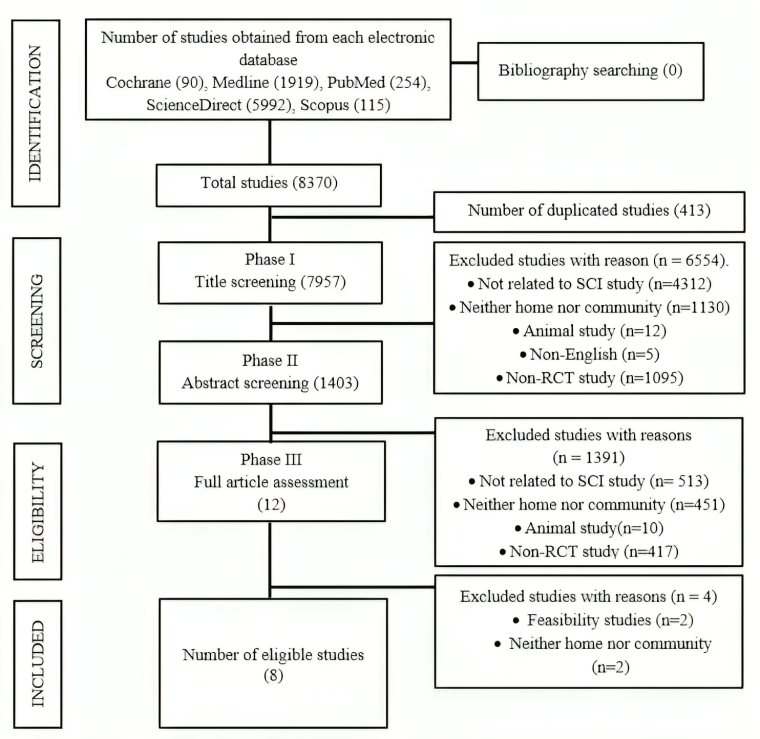
Home and community-based physical activity (HCPA) offer an accessible approach to enhancing functional recovery and independence in individuals with spinal cord injury (SCI). Despite its potential, evidence remains inconclusive due to heterogeneity in study designs, populations, and interventions. This review aimed to evaluate the variability in participant characteristics and intervention strategies in HCPA programs for SCI, assess their effectiveness, and identify research gaps. A systematic search was conducted in Cochrane, Medline, PubMed, ScienceDirect and Scopus for randomised controlled trials (RCTs) published between January 1994 and January 2024. Search terms combined Medical Subject Headings and free-text terms for SCI, home or community exercise and physical performance outcomes. From 8,370 records, eight RCTs met eligibility after rigorous screening. Study quality was assessed using the Physiotherapy Evidence Database scale. The included RCTs demonstrated moderate methodological quality and notable heterogeneity in demographic characteristics, injury profiles, interventions and outcome measures. Evidence suggests HCPA is feasible and yields moderate improvements in physical fitness and functional outcomes. Programs typically involved 2-4 sessions weekly, 30-60 minutes each, at moderate intensity, incorporating aerobic, resistance and wheelchair skills training. HCPA is practical and moderately effective for individuals with SCI. However, standardised, individualised protocols are urgently required. Future research should prioritise large-scale, high-quality RCTs to establish evidence-based guidelines for sustainable implementation in home and community rehabilitation contexts.
Keywords :
Community rehabilitation; functional recovery; home-based exercise; physical activity; spinal cord injury,
Correspondance Address
hafifi.hisham@ukm.edu.my
References
Ahmed, M.M., Okesanya, O.J., Olaleke, N.O., Adigun, O.A., Adebayo, U.O., Oso, T.A., Eshun, G., Lucero-Prisno, D.E. 2025. Integrating digital health innovations to achieve universal health coverage: Promoting health outcomes and quality through global public health equity. Healthcare 13(2): 1060. https://doi.org/10.3390/healthcare13091060
Azizan, A. 2024. Exercise and frailty in later life: A systematic review and bibliometric analysis of research themes and scientific collaborations. Int J Popul Stud 11(1): 3282. https://doi.org/10.36922/ijps.3282
Azizan, A., Anum, A., Faisal, A., Karnadipa, T. 2023. The effects of exercise and reminiscence therapy on depression and quality of life among the older adults with mild Alzheimer’s disease. J Adv Res Appl Sci Eng Technol 29(3): 185-97. https://doi.org/10.37934/araset.29.3.185197
Barria, P., Andrade, A., Yelincic, A., Córdova, B., Covarrubias-Escudero, F., Cifuentes, C., Appelgren-Gonzalez, J.P. 2025. Impact of a long-term home-based rehabilitation program on quality of life, balance, and autonomy in adults with disabilities. J Funct Morphol Kinesiol 10(1): 24. https://doi.org/10.3390/jfmk10010024
Brahmbhatt, D.H., Ross, H.J., Moayedi, Y. 2022. Digital technology application for improved responses to health care challenges: Lessons learned from COVID-19. Can J Cardiol 38(2): 279-91. https://doi.org/10.1016/j.cjca.2021.11.014
Budd, M.A., Gater, D.R., Channell, I. 2022. Psychosocial consequences of spinal cord injury: A narrative review. J Pers Med 12(7): 1178. https://doi.org/10.3390/jpm12071178
Cashin, A.G., McAuley, J.H. 2020. Clinimetrics: physiotherapy evidence database (PEDro) scale. J Physiother 66(1): 59. https://doi.org/10.1016/j. jphys.2019.08.005
Clemente-Suárez, V.J., Rubio-Zarapuz, A., Belinchón-de Miguel, P., Beltrán-Velasco, A.I., Martín-Rodríguez, A., Tornero-Aguilera, J.F. 2024. Impact of physical activity on cellular metabolism across neurological conditions: A narrative review. Cells 13(12): 1940. https://doi.org/10.3390/cells13231940
Declerck, L., Stoquart, G., Lejeune, T., Vanderthommen, M., Kaux, J.F. 2021. Barriers to development and expansion of adaptive physical activity and sports for individuals with physical disability in sports clubs and centres. Sci Sports 36(2): 120-7. https://doi.org/10.1016/j.scispo.2020.12.002
Di Giulio, F., Castellini, C., Palazzi, S., Tienforti, D., Antolini, F., Felzani, G., Baroni, M.G., Barbonetti, A. 2024. Correlates of metabolic syndrome in people with chronic spinal cord injury. J Endocrinol Invest 47(8): 2097-105. https://doi.org/10.1007/s40618-023-02298-8
Ding, W., Hu, S., Wang, P., Kang, H., Peng, R., Dong, Y., Li, F. 2022. Spinal cord injury: the global incidence, prevalence, and disability from the global burden of disease study 2019. Spine 47(21): 1532-40. https://doi.org/10.1097/BRS.0000000000004417
Froehlich-Grobe, K., Lee, J., Ochoa, C., Lopez, A, Sarker, E., Driver S., Shegog, R., Lin, S.J. 2022. Effectiveness and feasibility of the Workout on Wheels Internet Intervention (WOWii) for individuals with spinal cord injury: A randomized controlled trial. Spinal Cord 60(10): 862-74. https://doi.org/10.1038/s41393-02200787-w
Fryer, S., Caggiari, S., Major, D., Bader, D.L., Worsley, P.R. 2023. Continuous pressure monitoring of inpatient spinal cord injured patients: implications for pressure ulcer development. Spinal Cord 61(2): 111-8. https://doi.org/10.1038/s41393-022-00841-7
Grossmann, F., Flueck, J.L., Perret, C., Meeusen, R., Roelands, B. 2021. The thermoregulatory and thermal responses of individuals with a spinal cord injury during exercise, acclimation and by using cooling strategies: A systematic review. Front Physiol 12(1): 636997. https://doi.org/10.3389/fphys.2021.636997
Hadar-Frumer, M., Ten Napel, H., Yuste-Sánchez, M.J., Rodríguez-Costa, I. 2023. The International Classification of Functioning: Accuracy in aquatic activities among children with developmental delay. Children (Basel) 10(6): 908. https://doi.org/10.3390/children10050908
Harvey, L.A., Glinsky, J.V., Chu, J., Herbert, R.D., Liu, H., Jan, S., Billot, L., Scivoletto, G., Spooren, A.I., Seelen, H.A., Ben, M., et al. 2023. Early and intensive motor training to enhance neurological recovery in spinal cord injury: Trial protocol. Spinal Cord 61(6): 521-7. https://doi.org/10.1038/s41393-023-00908-z
Hisham, H., Justine, M., Hasnan, N., Manaf, H. 2022a. Effects of paraplegia fitness integrated training on physical function and exercise selfefficacy among individuals with spinal cord injury. Ann Rehabil Med 46(1): 33-44. https://doi.org/10.5535/arm.21127
Hisham, H., Rosley, H., Manaf, H., Justine, M. 2022b. Barriers and facilitators to physical activity among individuals with spinal cord injury: A systematic review. Malays J Med Health Sci 18(2): 46.
Hisham, H., Mohd Nordin, N.A., Aluwi, M.F. 2025. Perspective Chapter: Empowerment through movement: Enhancing psychosocial wellbeing in people with physical disabilities. In Movement as Medicine - Harnessing Physical Activity for Holistic Health across the Lifespan. IntechOpen 1(1): 139-64. https://doi.org/10.5772/intechopen.1009108
Jeyathevan, G., Craven, C., Cameron, J.I., Jaglal, S.B. 2020. Facilitators and barriers to supporting people with spinal cord injury in the community: Caregiver and care recipient perspectives. Disabil Rehabil 42(12): 1844-54. https://doi.org/10.1080/09638288.2018.1541102
Kirby, R.L., Mitchell, D., Sabharwal, S., McCranie, M., Nelson, A.L. 2016. Manual wheelchair skills training for community-dwelling veterans with spinal cord injury: A randomized controlled trial. PLoS One 11(1): e0168330. https://doi.org/10.1371/journal.pone.0168330
Koh, P.P.W., Mortenson, W.B. 2024. Evaluating a pilot community-based self-management program for adults with spinal cord injury. J Spinal Cord Med 47(5): 881-92. https://doi.org/10.1080/10790268.2023.2220510
Lu, Y., Shang, Z., Zhang, W., Pang, M., Hu, X., Dai, Y., Shen, R., Wu, Y., Liu, C., Luo, T., Wang, X., Liu, B., Zhang, L., Rong, L. 2024. Global incidence and characteristics of spinal cord injury from 2000 to 2021: A systematic review and metaanalysis. BMC Med 22(1): 285. https://doi.org/10.1186/s12916-024-03514-9
Mat Rosly, M., Halaki, M., Hasnan, N., Mat Rosly, H., Davis, G.M., Husain, R. 2018. Leisure time physical activity participation in individuals with spinal cord injury in Malaysia: Barriers to exercise. Spinal Cord 56(9): 806-18. https://doi.org/10.1038/s41393-018-0068-0
Manaf, H., Shaid, A., Justine, M., Hisham, H., Hasnan, N., Mohd Asmawi, U.M., Mustapa, A. 2021. Barriers to physical activity among persons with physical disability in a teaching hospital. Malays J Med Health Sci 17(2): 1-6.
Manaf, H., Tahir, I., Hisham, H., Justine, M., Hasnan, N. 2018. Return to work after spinal cord injury: A systematic review. Adv Sci Lett 24(4): 2374-7. https://doi.org/10.1166/asl.2018.10957
Mirbaha, S., Morgan, A., Tang, A., Smith-Turchyn, J., Richardson, J. 2023. Models of telehealth service delivery in adults with spinal cord injuries: Scoping review. JMIR Rehabil Assist Technol 10(1): e41186. https://doi.org/10.2196/41186
Mulroy, S.J., Thompson, L., Kemp, B., Hatchett, P.P., Newsam, C.J., Lupold, D.G., Haubert, L.L., Eberly, V., Ge, T.T., Azen, S.P., Winstein, C.J., Gordon, J.; Physical Therapy Clinical Research Network (PTClinResNet) 2011. Strengthening and optimal movements for painful shoulders in chronic spinal cord injury: A randomized controlled trial. Phys Ther 91(3): 305-24. https://doi.org/10.2522/ptj.20100182
Musselman, K.E., Shah, M., Zariffa, J. 2018. Rehabilitation technologies for spinal cord injury: Translational potential. J Neuroeng Rehabil 15(1): 40. https://doi.org/10.1186/s12984-018-0386-7
Nightingale, T.E., Rouse, P.C., Walhin, J.P., Thompson, D., Bilzon, J.L.J. 2018. Home-based exercise enhances health-related quality of life in spinal cord injury: A randomized controlled trial. Arch Phys Med Rehabil 99(11): 1998-2006. https://doi.org/10.1016/j.apmr.2018.05.008
Nightingale, T.E., Walhin, J.P., Thompson, D., Bilzon, J.L. 2017. Impact of exercise on cardiometabolic component risks in spinal cord–injured humans. Med Sci Sports Exerc 49(12): 2469-76. https://doi.org/10.1249/MSS.0000000000001390
Pelletier, C.A., Totosy de Zepetnek, J.O., MacDonald, M.J., Hicks, A.L. 2015. A 16-week randomized controlled trial evaluating the SCI physical activity guidelines. Spinal Cord 53(5): 363-7. https://doi.org/10.1038/sc.2014.167
Pelletier, C. 2023. Exercise prescription for persons with spinal cord injury: A review of physiological considerations and evidence-based guidelines. Appl Physiol Nutr Metab 48(8): 882-95. https://doi.org/10.1139/apnm-2023-0227
Peters, J., Abou, L., Rice, L.A., Dandeneau, K., Alluri, A., Salvador, A.F., Rice, I. 2021. Effectiveness of vigorous training on cardiorespiratory fitness in spinal cord injury: A systematic review. Spinal Cord 59(9): 1035-44. https://doi.org/10.1038/s41393-021-00669-7
Raguindin, P.F., Fränkl, G., Itodo, O.A., Bertolo, A., Zeh, R.M., Capossela, S., Minder, B., Stoyanov, J., Stucki, G., Franco, O.H., Muka, T., Glisic, M. 2021. Neurological level of spinal cord injury and cardiovascular risk factors: A metaanalysis. Spinal Cord 59(10): 1135-45. https://doi.org/10.1038/s41393-021-00678-6
Rayes, R., Ball, C., Lee, K., White, C. 2022. Adaptive sports in spinal cord injury: A systematic review. Curr Phys Med Rehabil Rep 10(4): 232-47. https://doi.org/10.1007/s40141-022-00358-3
Sivaramakrishnan, H., Phoenix, C., Quested, E., Thogersen-Ntoumani, C., Gucciardi, D.F., Cheval, B., Ntoumanis, N. 2023. More than just a walk in the park: A multi-stakeholder qualitative exploration of community-based walking sport programmes for middle-aged and older adults. Qual Res Sport Exerc Health 15(5): 772-88. https://doi.org/10.1080/2159676X.2023.2197450
Totosy de Zepetnek, J.O., Pelletier, C.A., Hicks, A.L., MacDonald, M.J. 2015. Following the SCI physical activity guidelines for 16 weeks does not improve vascular health: A randomized controlled trial. Arch Phys Med Rehabil 96(8): 1566-75. https://doi.org/10.1016/j.apmr.2015.05.019
van der Scheer, J.W., Goosey-Tolfrey, V.L., Valentino, S.E., Davis, G.M., Ho, C.H. 2021. Functional electrical stimulation cycling after spinal cord injury: A systematic review. J Neuroeng Rehabil 18(1): 99. https://doi.org/10.1186/s12984-02100882-8
Vachova, P., Fini, N.A., Wittwer, J., Peiris, C.L. 2024. Effectiveness of interventions to increase physical activity in adults with spinal cord injury: A systematic review. Disabil Rehabil 46(13): 5158-68. https://doi.org/10.1080/09638288.2023.2291550
Wedege, P., Mæland, S., Abrahamsen, F.E., Divanoglou, A. 2024. Peer-mentorship activity programmes for individuals with brain or spinal cord injuries: A mixed-methods review. Disabil Rehabil 46(15): 5442-57. https://doi.org/10.1080/09638288.2024.2310185
World Health Organisation. 2001. International Classification of Functioning, Disability and Health (ICF). Geneva: World Health Organization. https://www.who.int/publications/i/item/9241545429 [Accessed on 26 October 2025]
Worobey, L.A., Kirby, R.L., Heinemann, A.W., Krobot, E.A., Dyson-Hudson, T.A., Cowan, R.E., Pedersen, J.P., Shea, M., Boninger, M.L. 2016. Effectiveness of group wheelchair skills training: A randomized controlled trial. Arch Phys Med Rehabil 97(10): 1777-84. https://doi.org/10.1016/j.apmr.2016.04.006
Wouda, M.F., Lundgaard, E., Becker, F., Strøm, V. 2018. Effects of moderate- and high-intensity aerobic training in incomplete spinal cord injury: A randomized controlled trial. Spinal Cord 56(10): 955-63. https://doi.org/10.1038/s41393-018-0140-9
Yokota, K., Sakai, H., Kawano, O., Morishita, Y., Masuda, M., Hayashi, T., Maeda, T. 2024. Changing trends in traumatic spinal cord injury in an aging society: Epidemiology of 1152 cases over 15 years from a single center in Japan. PLoS One 19(3): e0298836. https://doi.org/10.1371/journal.pone.0298836
Zhou, W., Zhang, X., Lyu, X. 2025. Monitoring utilisation patterns of home- and communitybased services for healthy ageing: A crosssectional study. BMC Geriatr 25(1): 1-12. https://doi.org/10.1186/s12877-025-05918-5


