
Development and Validation of Questionnaire about Knowledge, Attitude and Practice of Primary School Teachers on Myopia Children in Malaysia
Teachers’ KAP on Myopia in Malaysian Schoolchildren
Vol. 21 No. 2 : 2026 (762-780)

Abstract
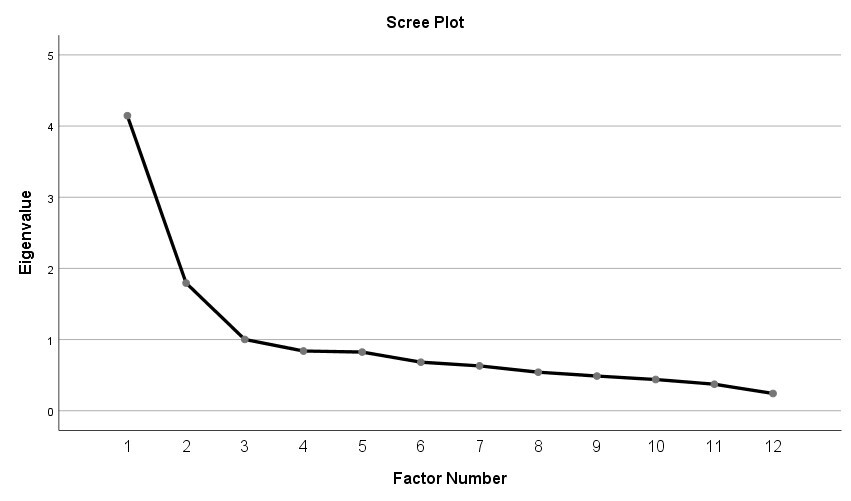
This study aims to develop and validate a questionnaire on knowledge, attitude and practice (KAP) of primary school teachers on myopia among schoolchildren in Malaysia. Four phases were used to develop the questionnaire, namely: (i) questionnaire item generation via systemic literature review; (ii) content validity by 10 expert panels and face validity by 10 primary school teachers; (iii) feasibility study among 64 primary school teachers; and (iv) construct validity and reliability were determined by administrating the questionnaire to 396 and 64 primary school teachers, respectively. The final MyT-KAPQ consists of four sections: demography, knowledge, attitude and practice with 47 items. Knowledge domain items showed high content validity index (0.78-1.0) with Kappa values higher than 0.74. Acceptable scores of 0.844 and 0.881 were obtained for Kaiser-Meyer Olkin sampling adequacy for both attitude and practice domains and Bartlett’s Test of sphericity was significant (χ2 = 0.00, p < 0.001). Factor analysis resulted in each attitude and practice domain containing three factors with 12 items. All items in the KAP domains showed acceptable values >0.70 for Cronbach’s α and good test-retest reliability values. The final version of the questionnaire comprised 47 items across three sections namely KAP and demonstrated satisfactory psychometric properties for assessing the KAP of primary school teachers concerning childhood myopia in Malaysia
Keywords :
Attitude; knowledge; myopia; practice; primary school teachers,
Correspondance Address
sumithira@ukm.edu.my
References
Abd Rahman, M.H., Amirtharatnam, P., SharanjeetKaur, S., Narayanasamy, S., Rasdi, H.F., Bastion, M.L. 2023. Development of knowledge, attitude and practice questionnaire for agerelated macular degeneration patients. Int J Ophthalmol 16(4): 589-600. https://doi.org/10.18240/ijo.2023.04.13
Agarwal, A., Ranjan, P., Rohilla, P., Saikaustubh, Y., Sahu, A., Dwivedi, S.N., Baitha, U., Kumar, A. 2021. Development and validation of a questionnaire to assess preventive practices against COVID-19 pandemic in the general population. Prev Med Rep 22: 101339. https://doi.org/10.1016/j.pmedr.2021.101339
Andrade, C., Menon, V., Ameen, S., Kumar Praharaj, S. 2020. Designing and conducting knowledge, attitude, and practice surveys in psychiatry: practical guidance. Indian J Psychol Med 42(5): 478-81. https://doi.org/10.1177/0253717620946111
Arifin, W.N. 2018. A web-based sample size calculator for reliability studies. Educ Med J 10(3): 67-76. https://doi.org/10.21315/eimj2018.10.3.8
Asún, R.A., Rdz-Navarro, K., Alvarado, J.M. 2016. Developing multidimensional Likert scales using item factor analysis: The case of fourpoint items. Sociol Methods Res 45(1): 109-33. https://doi.org/10.1177/0049124114566716
Benzir, M., Afroze, A., Zahan, A., Naznin, R.A., Khanam, A., Sumi, S.A., Haq, M.A., Lugova, H., Haque, M. 2022. A study linking axial length, corneal curvature, and eye axis with demographic characteristics in the emmetropic eyes of Bangladeshi people. Cureus 14(10): e29925. https://doi.org/10.7759/cureus.29925
Costello, A.B., Osborne, J. 2005. Best practices in exploratory factor analysis: Four recommendations for getting the most from your analysis. Pract Assess Res Eval 10(1): 1-9. Cui, L., He, A., Wang, X., Wang, Y., Huang, X., Ni, Z. 2022. Development and validation of a competency evaluation model for hospital infection prevention and control practitioners in the post-pandemic era: A mixed methods study. J Hosp Infect 119: 132-40. https://doi.org/10.1016/j.jhin.2021.08.028
Eze, N.M., Asogwa, O.C., Eze, C.M. 2021. Principal component factor analysis of some development factors in Southern Nigeria and its extension to regression analysis. J Adv Math Comput Sci 36(3): 132-60. https://doi.org/10.9734/JAMCS/2021/v36i330351
Ghani, N.D., Abd Rahman, M.H., Mohamad Fadzil, N., Mohammed, Z., Mohd Rasdi, H.F., Shafie, N.S. 2023. Development and validation of parental knowledge, attitude and practice in eye problem among children questionnaire (PEPCKAPQ). PLoS One 18(9): e0291062. https://doi.org/10.1371/journal.pone.0291062
Goni, M.D., Naing, N.N., Hasan, H., Wan-Arfah, N., Deris, Z.Z., Arifin, W.N., Hussin, T.M., Abdulrahman, A.S., Baaba, A.A., Arshad, M.R. 2020. Development and validation of knowledge, attitude and practice questionnaire for prevention of respiratory tract infections among Malaysian Hajj pilgrims. BMC Public Health 20:1-0. https://doi.org/10.1186/s12889020-8269-9
Gunawan, J., Marzilli, C., Aungsuroch, Y. 2021. Establishing appropriate sample size for developing and validating a questionnaire in nursing research. Belitung Nurs J 7(5): 356-60. https://doi.org/10.33546/bnj.1927
Hair, J.F., Anderson, R.E., Babin, B.J., Black, W.C. 2010. Multivariate data analysis: A global perspective. Upper Saddle River (NJ): Pearson Education Han, X., Liu, C., Chen, Y., He, M. 2022. Myopia prediction: A systematic review. Eye (London, England) 36(5): 921-9.
Henson, R.K., Roberts, J.K. 2006. Use of exploratory factor analysis in published research: Common errors and some comment on improved practice. Educ Psychol Meas 66(3): 393-416. https://doi.org/10.1177/0013164405282485
Holden, B.A., Fricke, T.R., Wilson, D.A., Jong, M., Naidoo, K.S., Sankaridurg, P., Wong, T.Y., Naduvilath, T.J., Resnikoff, S. 2016. Global prevalence of myopia and high myopia and temporal trends from 2000 through 2050. Ophthalmology 123(5): 1036-42. https://doi.org/10.1016/j.ophtha.2016.01.006
Hong, Q.N., Pluye, P., Fàbregues, S., Bartlett, G., Boardman, F., Cargo, M., Dagenais, P., Gagnon, MP., Griffiths, F., Nicolau, B., O’Cathain, A., Rousseau, M.C., Vedel, I. 2019. Improving the content validity of the mixed methods appraisal tool: A modified e-Delphi study. J Clin Epidemiol 111: 49-59.e1. https://doi.org/10.1016/j.jclinepi.2019.03.008
Ismail, L.A., Sukumaran, S. 2022. Prevalence of refractive errors among school children in Wangsa Maju, Kuala Lumpur, Malaysia. Med Hypothesis Discov Innov Optom 3(3): 106-12. https://doi.org/10.51329/mehdioptometry158
Koo, T.K., Li, M.Y. 2016. A guideline of selecting and reporting intraclass correlation coefficients for reliability research. J Chiropr Med 15(2): 15563. https://doi.org/10.1016/j.jcm.2016.02.012
Krejcie, R.V., Morgan, D.W. 1970. Determining sample size for research activities. Educ Psychol Meas 30(3): 607-10. https://doi.org/10.1177/00131644700300030
Li, M., Tan, C.S., Foo, L.L., Sugianto, R., Toh, J.Y., Sun, C.H., Yap, F., Sabanayagam, C., Chong, F.F., Saw, S.M. 2022. Dietary intake and associations with myopia in Singapore children. Ophthalmic Physiol Opt 42(2): 319-26. https://doi.org/10.1111/opo.12929
Lloret, S., Ferreres, A., Hernández, A., Tomás, I. 2017. The exploratory factor analysis of items: Guided analysis based on empirical data and software. An Psicol 33(2): 417-32. https://doi.org/10.6018/analesps.33.2.270211
Ngah, H., Mohd Hairon, S., Hamzah, N.A., Noordin, S., Shafei, M.N. 2022. Development and validation of knowledge, attitude, and practice questionnaire: toward safe working in confined spaces. Int J Environ Res Public Health 19(3): 1242. https://doi.org/10.3390/ijerph19031242
Ntumi, S., Agbenyo, S., Bulala, T. 2023. Estimating the Psychometric Properties (Item Difficulty, Discrimination and Reliability Indices) of Test Items Using Kuder-Richardson Approach (KR20). Shanlax Int J Educ 11(3): 18-28. https://doi.org/10.34293/education.v11i3.6081
Park, D.I. 2021. Development and validation of a knowledge, attitudes and practices questionnaire on COVID-19 (KAP COVID-19). Int J Environ Res Public Health 18(14):7493. https://doi.org/10.3390/ijerph18147493
Polit, D.F., Beck, C.T., Owen, S.V. 2007. Is the CVI an acceptable indicator of content validity? Appraisal and recommendations. Res Nurs Health 30(4): 459-67. https://doi.org/10.1002/nur.20199
Polit, D.F., Beck, C.T. 2006. The content validity index: are you sure you know what's being reported? Critique and recommendations. Res Nurs Health 29(5): 489-97. https://doi.org/10.1002/nur.20147
Saefi, M., Fauzi, A., Kristiana, E., Adi, W.C., Muchson, M., Setiawan, M.E., Islami, N.N., Ningrum, D.E.A.F., Ikhsan, M.A., Ramadhani, M. 2020. Validating of knowledge, attitudes, and practices questionnaire for prevention of COVID-19 infections among Undergraduate Students: A RASCH and Factor Analysis. EURASIA J Math Sci Tech Educ 16(12): em1926. https://doi.org/10.29333/ejmste/9352
Saw, S.M., Goh, P.P., Cheng, A., Shankar, A., Tan, D.T., Ellwein, L.B. 2006. Ethnicity-specific prevalences of refractive errors vary in Asian children in neighbouring Malaysia and Singapore. Br J Ophthalmol 90(10): 1230-5. https://doi.org/10.1136/bjo.2006.093450
Saw, S.M., Zhang, M.Z., Hong, R.Z., Fu, Z.F., Pang, M.H., Tan, D.T. 2002. Near-work activity, nightlights, and myopia in the Singapore-China study. Arch Ophthalmol 120(5): 620-7. https://doi.org/10.1001/archopht.120.5.620
Sankaridurg, P., Tahhan, N., Kandel, H., Naduvilath, T., Zou, H., Frick, K.D., Marmamula, S., Friedman, D.S., Lamoureux, E., Keeffe, J., Walline, J.J. 2021. IMI impact of myopia. Invest Ophthalmol Visual Sci 62(5): 2. https://doi.org/10.1167/iovs.62.5.2
Shrestha, N. 2021. Factor analysis as a tool for survey analysis. Am J Appl Math Stat 9(1): 4-11. https:// doi.org/10.12691/ajams-9-1-2 Tan, S. 2009. Misuses of KR-20 and Cronbach’s alpha reliability coefficients. Educ Sci 34(152): 101-12.
Tariq, F., Mobeen, R., Wang, X., Lin, X., Bao, Q., Liu, J., Gao, H. 2023. Advances in myopia prevention strategies for school-aged children: a comprehensive review. Front Public Health 11: 1226438. https://doi.org/10.3389/fpubh.2023.1226438
Tegegne, B., Wondimu, H. 2023. Validation of the emotional intelligence scale for University Instructors in Ethiopia. J Ethiop Stud 6(2): 11954.
Tsai, T.H., Liu, Y.L., Ma, I.H., Su, C.C., Lin, C.W., Lin, L.L., Hsiao, C.K., Wang, I.J. 2021. Evolution of the prevalence of myopia among Taiwanese schoolchildren: a review of survey data from 1983 through 2017. Ophthalmology 128(2): 290-301. https://doi.org/10.1016/j.ophtha.2020.07.017
Watkins, M.W. 2021. A step-by-step guide to exploratory factor analysis with SPSS. New York: Routledge. Wilhelmsen, G.B., Felder, M. 2020. Learning is visual: Why teachers need to know about vision. In School Management in the 21st Century IntechOpen.
Williams, B., Onsman, A., Brown, T. 2010. Exploratory factor analysis: A five-step guide for novices. Australas J Paramed 8: 1-3. https://doi.org/10.33151/ajp.8.3.93
World Health Organization (WHO). 2008. Advocacy, communication and social mobilization for TB control: A guide to developing knowledge, attitude and practice surveys. https://www.who.int/publications/i/item/9789241596176 [Accessed on 11 May 2022}
Wu, M.J., Zhao, K., Fils-Aime, F. 2022. Response rates of online surveys in published research: A metaanalysis. Comput Human Behav 7: 100206. https://doi.org/10.1016/j.chbr.2022.100206
Xu, J., Shi, Y., Li, S., Ma, J., Zhang, J., Shen, Y. 2024. Development and reliability testing of a risk factor and risk outcome assessment scale for nurses in “internet+ nursing services” for the elderly. BMC Nurs 23(1): 54. https://doi.org/10.1186/s12912-024-01698-2
Yun, V.W., Ulang, N.M., Husain, S.H. 2023. Measuring the internal consistency and reliability of the hierarchy of controls in preventing infectious diseases on construction sites: The KuderRichardson (KR-20) and Cronbach’s Alpha. J Adv Res Appl Sci Eng Technol 33(1): 392-405. https://doi.org/10.37934/araset.33.1.392405
Yusoff, M.S., Arifin, W.N., Hadie, S.N. 2021. ABC of questionnaire development and validation for survey research. Educ Med J 13(1): 97-108. https://doi.org/10.21315/eimj2021.13.1.10


