
COVID-19 Quality of Life (CO-19_QoL) Questionnaire for Investigation of Health-Related Quality of Life of COVID-19 Patients in Selangor: A Translation and Validation Study
Validation of Malay CO-19_QoL Questionnaire
Vol. 21 No. 2 : 2026 (1020-1033)

Abstract
The impact of Coronavirus Disease 2019 (COVID-19) on quality of life (QoL) appears to be substantially
underestimated. In Malaysia, Selangor consistently ranked among the states with the highest reported
COVID-19 cases. Generic QoL instruments typically assessed broad domains such as mental well-being,
physical function, social function and pain, which can all be impacted by any disease. Hence, diseasespecific
tools are more sensitive in detecting clinical changes or differentiating patients according to disease
severity. This study aims to assess the validity and reliability of the Malay version of the COVID-19 Quality
of Life (CO-19_QoL) questionnaire for the use in the Malaysian context. A cross-sectional study involving
330 adult COVID-19 patients was conducted in the state of Selangor. The questionnaire was translated
and culturally adapted following International Society for Pharmacoeconomics and Outcomes Research
(ISPOR) guidelines, including forward backward translation and expert review to ensure conceptual and
linguistic equivalence. It demonstrated excellent content validity (Kappa > 0.8), confirming that the items
are relevant to COVID-19 symptoms and accurately translated. Internal consistency was high (Cronbach’s
alpha = 0.919), while test-retest showed excellent reliability [Intraclass Correlation Coefficient (ICC) =
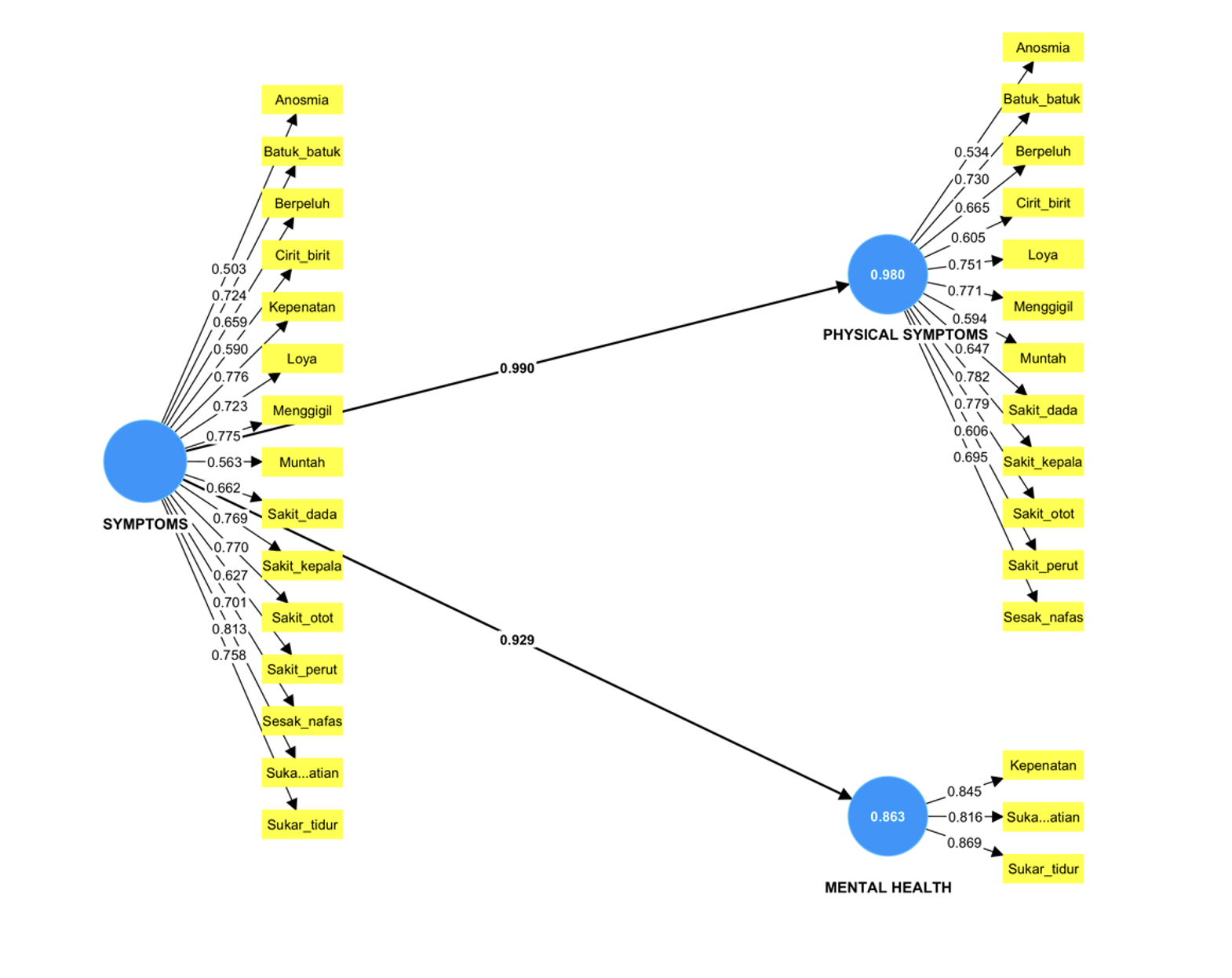
0.896, p < 0.001]. Construct validity analyses identified a single 15-item domain to be reliable and valid
to measure the QoL of COVID-19 patients. The CO-19_QoL is a promising new instrument for measuring
disease-specific QoL. It is easy to use, acceptable to patients, and meets rigorous reliability and validity
standards. Also, CO-19_QoL enables a more thorough evaluation of HRQoL among COVID-19 patients
in Selangor when used together with a generic QoL instrument.
Keywords :
COVID-19; health-related quality of life; quality of life; translation; validation,
Correspondance Address
maznahd@ummc.edu.my
References
Amdal, C.D., Pe, M., Falk, R.S., Piccinin, C., Bottomley, A., Arraras, J.I., Darlington, A.S., Hofsø, K., Holzner, B., Jørgensen, N.M.H. 2021. Health-related quality of life issues, including symptoms, in patients with active COVID-19 or post COVID-19: A systematic literature review. Qual Life Res 30(12): 3367–3381. https://doi.org/10.1007/s11136-021-02908-z
Arifin, W.N. 2013. Sample size for questionnaire validation studies. https://wnarifin.github.io/workshop/qvw2017/Sample%20size%20for%20questionnaire%20validation%20studies%20v1_1.pdf [Accessed on 12 April 2024].
Arifin, W.N., Yusoff, M.S.B. 2016. Confirmatory factor analysis of the Universiti Sains Malaysia emotional quotient inventory among medical students in Malaysia. SAGE Open 6(2): 2158244016650240. https://doi.org/10.1177/2158244016650240
Barani, S., Bhatnagar, T., Natarajan, M., Gayathri, K., Sonekar, H.B., Sasidharan, A., Selvavinayagam, T., Bagepally, B.S. 2022. Health-related quality of life among COVID-19 individuals: A cross-sectional study in Tamil Nadu, India. Clin Epidemiol Glob Health 13: 100943. https://doi.org/10.1016/j.cegh.2021.100943
Bhatraju, P.K., Ghassemieh, B.J., Nichols, M., Kim, R., Jerome, K.R., Nalla, A.K., Greninger, A.L., Pipavath, S., Wurfel, M.M., Evans, L. 2020. COVID-19 in critically ill patients in the Seattle region: Case series. N Engl J Med 382(21): 2012–2022. https://doi.org/10.1056/NEJMoa2004500
Bjordal, K., Kaasa, S. 1992. Psychometric validation of the EORTC Core Quality of Life Questionnaire, 30-item version and a diagnosis-specific module for head and neck cancer patients. Acta Oncol 31(3): 311–320. https://doi.org/10.3109/02841869209108178
Bonaccorsi, G., Pierri, F., Cinelli, M., Flori, A., Galeazzi, A., Porcelli, F., Schmidt, A.L., Valensise, C.M., Scala, A., Quattrociocchi, W. 2020. Economic and social consequences of human mobility restrictions under COVID-19. Proc Natl Acad Sci USA 117(27): 15530–15535. https://doi.org/10.1073/pnas.2007658117
Chan, J.F.W., Yuan, S., Kok, K.H., To, K.K.W., Chu, H., Yang, J., Xing, F., Liu, J., Yip, C.C.Y., Poon, R.W.S. 2020. A familial cluster of pneumonia associated with the 2019 novel coronavirus indicating person-to-person transmission: A study of a family cluster. Lancet 395(10223): 514–523. https://doi.org/10.1016/S0140-6736(20)30154-9
Chen, K.Y., Li, T., Gong, F., Zhang, J.S., Li, X.K. 2020. Predictors of health-related quality of life and influencing factors for COVID-19 patients, a follow-up at one month. Front Psychiatry 11: 668. https://doi.org/10.3389/fpsyt.2020.00668
Department of Statistics Malaysia. 2020a. Average incidence rate of COVID-19 cases per 100,000 population, October 13–26, 2020. https://www.dosm.gov.my/portal-main/article/covid-19 [Accessed on 19 October 2024].
Department of Statistics Malaysia. 2020b. Population by ethnic group, Selangor, 2020. https://pqi.stats.gov.my/searchBI.php?tahun=2020&kodData=2&kodJadual=1&kodCiri=7&kodNegeri=10 [Accessed on 2 April 2024].
EuroQol Research Foundation. 2019. EQ-5D-5L User Guide. https://euroqol.org/information-and-support/documentation/user-guides/ [Accessed on 3 May 2024].
Hair, J.F., Risher, J.J., Sarstedt, M., Ringle, C.M. 2019. When to use and how to report the results of PLS-SEM. Eur Bus Rev 31(1): 2–24. https://doi.org/10.1108/EBR-11-2018-0203
Hair, J.F., Sarstedt, M., Ringle, C.M., Mena, J.A. 2012. An assessment of the use of partial least squares structural equation modeling in marketing research. J Acad Mark Sci 40(3): 414–433. https://doi.org/10.1007/s11747-011-0261-6
Henseler, J., Ringle, C.M., Sarstedt, M. 2015. A new criterion for assessing discriminant validity in variance-based structural equation modeling. J Acad Mark Sci 43(1): 115–135. https://doi.org/10.1007/s11747-014-0403-8
Hui, D., Joynt, G., Wong, K.T., Gomersall, C., Li, T., Antonio, G., Ko, F., Chan, M., Chan, D., Tong, M. 2005. Impact of severe acute respiratory syndrome (SARS) on pulmonary function, functional capacity and quality of life in a cohort of survivors. Thorax 60(5): 401–409. https://doi.org/10.1136/thx.2004.03020
Jandhyala, R. 2021. Neutral theory: Applicability and neutrality of using generic health-related quality of life tools in diseases or conditions where specific tools are available. BMC Med Res Methodol 21(1): 1–8. https://doi.org/10.1186/s12874-021-01279-w
Kaiser, H.F. 1974. An index of factorial simplicity. Psychometrika 39(1): 31–36. https://doi.org/10.1007/BF02291575
Karim, K.N. 2020. Health Ministry gets extra RM1bil allocation under stimulus package. New Straits Times. https://www.nst.com.my/news/nation/2020/03/578723/health-ministry-gets-extra-rm1bil-allocation-under-stimulus-package [Accessed on 23 June 2021].
Keller, K.G., Reangsing, C., Schneider, J.K. 2020. Clinical presentation and outcomes of hospitalized adults with COVID-19: A systematic review. J Adv Nurs 76(12): 3235–3257. https://doi.org/10.1111/jan.14558
Kim, E.S., Chin, B.S., Kang, C.K., Kim, N.J., Kang, Y.M., Choi, J.P., Oh, D.H., Kim, J.H., Koh, B., Kim, S.E. 2020. Clinical course and outcomes of patients with severe acute respiratory syndrome coronavirus 2 infection: A preliminary report of the first 28 patients from the Korean cohort study on COVID-19. J Korean Med Sci 35(13): e142. https://doi.org/10.3346/jkms.2020.35.e142
Koo, T.K., Li, M.Y. 2016. A guideline of selecting and reporting intraclass correlation coefficients for reliability research. J Chiropr Med 15(2): 155–163. https://doi.org/10.1016/j.jcm.2016.02.012
Lamping, D.L., Schroter, S., Marquis, P., Marrel, A., Duprat-Lomon, I., Sagnier, P.P. 2002. The community-acquired pneumonia symptom questionnaire: A new, patient-based outcome measure to evaluate symptoms in patients with community-acquired pneumonia. Chest 122(3): 920–929. https://doi.org/10.1378/chest.122.3.920
Lim, J., Park, S., Park, C., Kim, B. 2023. Survey instrument for related to the use of outcome measures in physical therapy: A systematic review. J Int Acad Phys Ther Res 14(3): 2923-30. https://doi.org/10.20540/JIAPTR.2023.14.3.2923
Lim, L.L. 2020. The socioeconomic impacts of COVID-19 in Malaysia: Policy review and guidance for protecting the most vulnerable and supporting enterprises. International Labour Organization. https://share.google/KZmQnY5YWFHreSwOR [Accessed on 9 February 2024].
Ministry of Finance Malaysia. 2020. Budget 2021 Speech. https://www.mof.gov.my/portal/arkib/budget/2021/bs21.pdf [Accessed on 19 March 2023].
Patil, V.H., Singh, S.N., Mishra, S., Donavan, D.T. 2017. Parallel analysis engine to aid in determining number of factors to retain using R. https://analytics.gonzaga.edu/parallelengine [Accessed on 30 September 2024].
Payakachat, N., Ali, M.M., Tilford, J.M. 2015. Can the EQ-5D detect meaningful change? A systematic review. Pharmacoeconomics 33: 1137–1154. https://doi.org/10.1007/s40273-015-0295-6
Poudel, A.N., Zhu, S., Cooper, N., Roderick, P., Alwan, N., Tarrant, C., Ziauddeen, N., Yao, G.L. 2021. Impact of COVID-19 on health-related quality of life of patients: A structured review. PLoS One 16(10): e0259164. https://doi.org/10.1371/journal.pone.0259164
Rolstad, S., Adler, J., Rydén, A. 2011. Response burden and questionnaire length: Is shorter better? A review and meta-analysis. Value Health 14(8): 1101–1108. https://doi.org/10.1016/j.jval.2011.06.003
Sharma, A., Tiwari, S., Deb, M.K., Marty, J.L. 2020. Severe acute respiratory syndrome coronavirus-2 (SARS-CoV-2): A global pandemic and treatment strategies. Int J Antimicrob Agents 56(2): 106054. https://doi.org/10.1016/j.ijantimicag.2020.106054
Simpson, R., Robinson, L. 2020. Rehabilitation after critical illness in people with COVID-19 infection. Am J Phys Med Rehabil 99(6): 470-4. https://doi.org/10.1097/PHM.0000000000001443
Taquet, M., Luciano, S., Geddes, J.R., Harrison, P.J. 2021. Bidirectional associations between COVID-19 and psychiatric disorder: Retrospective cohort studies of 62 354 COVID-19 cases in the USA. Lancet Psychiatry 8(2): 130–140. https://doi.org/10.1016/S2215-0366(20)30462-4
Tavakol, M., Wetzel, A. 2020. Factor analysis: A means for theory and instrument development in support of construct validity. Int J Med Educ 11: 245–247. https://doi.org/10.5116/ijme.5f96.0f4a
Tsang, S., Royse, C.F., Terkawi, A.S. 2017. Guidelines for developing, translating, and validating a questionnaire in perioperative and pain medicine. Saudi J Anaesth 11(Suppl 1): S80. https://doi.org/10.4103/sja.SJA_203_17
Turner, N., Campbell, J., Peters, T.J., Wiles, N., Hollinghurst, S. 2013. A comparison of four different approaches to measuring health utility in depressed patients. Health Qual Life Outcomes 11(1): 81. https://doi.org/10.1186/1477-7525-11-81
Valentino-DeVries, J., Lu, D., Dance, G.J.X. 2020. Location data says it all: Staying at home during coronavirus is a luxury. The New York Times. https://www.nytimes.com/interactive/2020/04/03/us/coronavirus-stay-home-rich-poor.html [Accessed on 4 January 2023].
Wang, D., Hu, B., Hu, C., Zhu, F., Liu, X., Zhang, J., Wang, B., Xiang, H., Cheng, Z., Xiong, Y. 2020. Clinical characteristics of 138 hospitalized patients with 2019 novel coronavirus-infected pneumonia in Wuhan, China. JAMA 323(11): 1061–1069. https://doi.org/10.1001/jama.2020.1585
Wild, D., Grove, A., Martin, M., Eremenco, S., McElroy, S., Verjee-Lorenz, A., Erikson, P. 2005. Principles of good practice for the translation and cultural adaptation process for patient-reported outcomes (PRO) measures: Report of the ISPOR task force for translation and cultural adaptation. Value Health 8(2): 94–104. https://doi.org/10.1111/j.1524-4733.2005.04054.x
World Health Organization. 2020. COVID-19 Weekly Epidemiological Update. https://www.who.int/publications/m/item/weekly-epidemiological-update---29-december-2020 [Accessed on 30 December 2020].
World Health Organization. 2024. WHO Coronavirus (COVID-19) Dashboard. https://data.who.int/dashboards/covid19/cases?n=o [Accessed on 7 August 2024].
Yang, X., Yu, Y., Xu, J., Shu, H., Liu, H., Wu, Y., Zhang, L., Yu, Z., Fang, M., Yu, T., Wang, Y., Pan, S., Zhou, X., Yuan, S., Shang, Y. 2020. Clinical course and outcomes of critically ill patients with SARS-CoV-2 pneumonia in Wuhan, China: A single-centered, retrospective, observational study. Lancet Respir Med 8(5): 475–481. https://doi.org/10.1016/S2213-2600(20)30103-X


