Association between Confidence in Performing Direct Ophthalmoscopy and Retinoscopy with Eye and Hand Dominance: A Cross-sectional Survey Study
Self-Confidence with Ophthalmoscopy and Retinoscopy
Vol. 21 No. 2 : 2026 (832-843)

Abstract
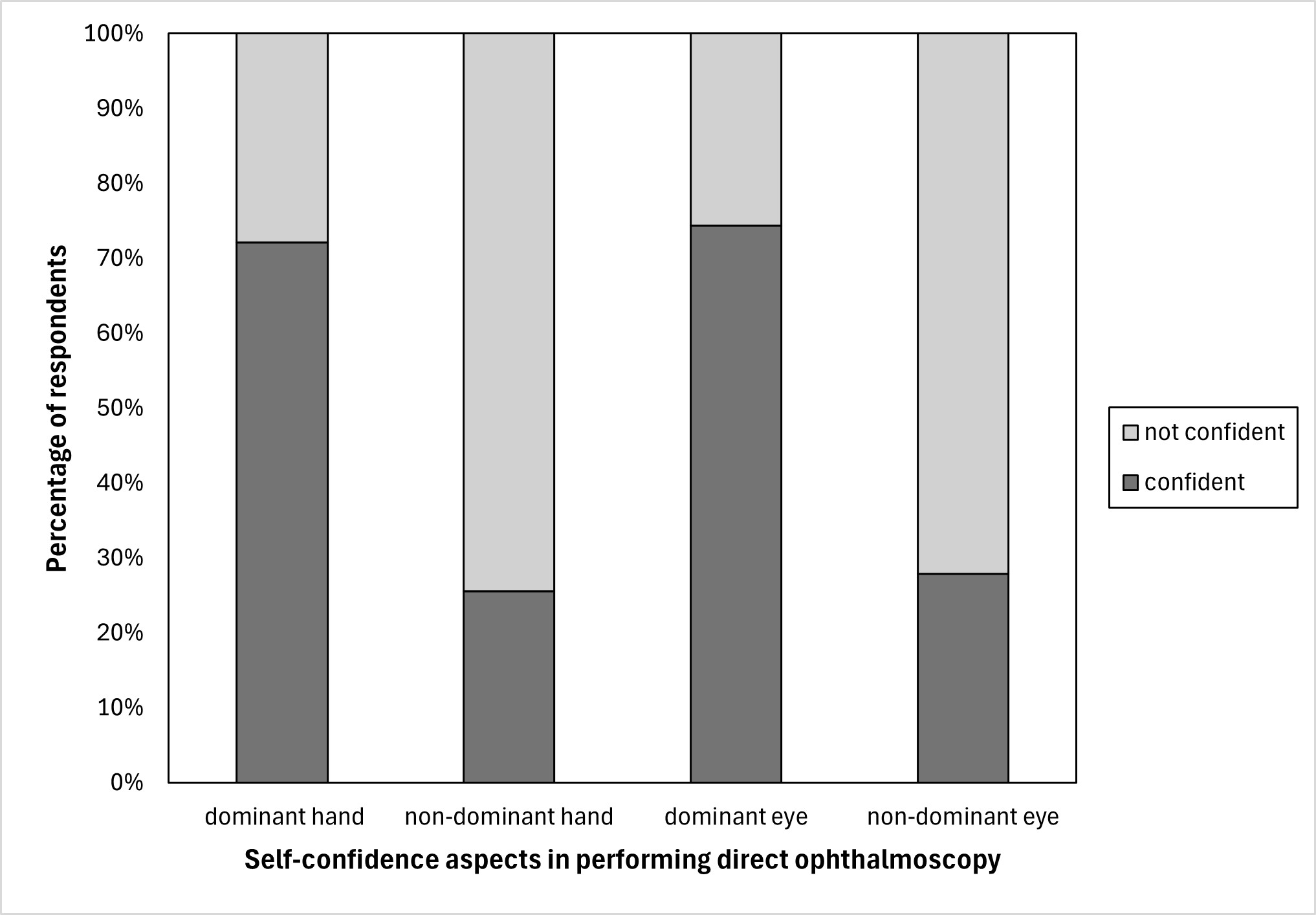
Direct ophthalmoscopy and retinoscopy are essential clinical skills in optometry training that must be mastered before students progress into their clinical year. Thus, assessing their confidence in these skills’ acquisition is crucial as they require both cognitive understanding and practical proficiency. The purpose of this study was to determine the confidence of preclinical year optometry students in performing direct ophthalmoscopy and retinoscopy, with consideration of eye and hand dominancy. The participants consisted of students enrolled in the undergraduate optometry program in their preclinical year. Confidence levels in performing direct ophthalmoscopy and retinoscopy were assessed using validated questionnaires. Confidence in direct ophthalmoscopy was higher when performed with the dominant eye (72.1%) compared to the non-dominant eye (25.6%), and with the dominant hand (74.4%) compared to the non-dominant hand (27.9%). There were highly significant associations between confidence in direct ophthalmoscopy and both hand dominancy (χ2(1) = 18.615, p < 0.001) and eye dominancy (χ2(1) = 18.615, p < 0.001). Similarly, a low proportion of students reported confidence when retinoscopy was performed with their non-dominant eye (28%) and dominant hand (22%), with highly significant associations between confidence level and hand dominancy (χ2(1) = 17.993, p < 0.001) and eye dominancy (χ2(1) = 14.492, p < 0.001). Fewer than 50% of students were confident in discriminating retinoscopy reflexes associated with astigmatism. In conclusion, a large proportion of preclinical students lacked confidence in performing direct ophthalmoscopy and retinoscopy using their non-dominant hand and eye. Clinical teaching should nurture ambidexterity among preclinical students to enhance confidence in performing these crucial clinical skills.
Keywords :
Clinical skills; confidence; direct ophthalmoscopy; eye dominance; hand dominance; retinoscopy,
Correspondance Address
izzuddin.hairol@ukm.edu.my
References
Abbas, K., Lo, C., Gardiner, J.A. 2024. Assessing utility of a simple low-cost simulator model to improve direct ophthalmoscopy skills amongst medical students. Discov Educ 3(1): 228. https://doi.org/10.1007/s44217-024-00342-0
Akbari, O., Sahibzada, J. 2020. Students’ self-confidence and its impacts on their learning process. Am Int J Soc Sci Res 5: 1-15. https://doi.org/10.46281/aijssr.v5i1.462
Ayub, G., Souza, R.B., de Albuquerque, A.M., de Vasconcellos, J.P.C. 2021. Comparison of conventional and wide field direct ophthalmoscopy on medical students’ self-confidence for fundus examination: A 1-year follow-up. BMC Med Educ 21: 507. https://doi.org/10.1186/s12909-021-02942-y
Bharadwaj, S.R., Malavita, M., Jayaraj, J. 2014. A psychophysical technique for estimating the accuracy and precision of retinoscopy. Clin Exp Optom 97(2): 164-70. https://doi.org/10.1111/cxo.12112
Carneiro, V.L.A., Jorge, J. 2020. Competencies and training needs of the Portuguese optometrists - A national inquiry. J Optom 13: 88-95. https://doi.org/10.1016/j.optom.2019.12.003
Chan, C.K.Y., Luk, L.Y.Y. 2021. Development and validation of an instrument measuring undergraduate students’ perceived holistic competencies. Assess Eval High Educ 46(3): 467-82. https://doi.org/10.1080/02602938.2020.1784392
Chukwuyem, E.C., Musa, M.J., Zeppieri, M. 2023. Prescribing glasses for presbyopia. StatPearls Publishing, Treasure Island (FL).
Cohen, J. 2013. Statistical power analysis for the behavioral sciences. Routledge. https://doi.org/10.4324/9780203771587
Colomer, J., Serra, T., Cañabate, D., Bubnys, R. 2020. Reflective learning in higher education: Active methodologies for transformative practices. Sustainability 12: 3827. https://doi.org/10.3390/su12093827
Elendu, C., Amaechi, D.C., Okatta, A.U., Amaechi, E.C., Elendu, T.C., Ezeh, C.P., Elendu, I.D. 2024. The impact of simulation-based training in medical education: A review. Medicine (Baltimore) 103: e38813. https://doi.org/10.1097/MD.0000000000038813
Erdfelder, E., Faul, F., Buchner, A. 1996. GPOWER: A general power analysis program. Behav Res Methods Instrum Comput 28(1): 1-11. https://doi.org/10.3758/BF03203630
Estay, A.M., Plaza-Rosales, I., Torres, H.R., Cerfogli, F.I. 2023. Training in retinoscopy: Learning curves using a standardized method. BMC Med Educ 23(1): 874. https://doi.org/10.1186/s12909-023-04750-y
Gabbard, T., Romanelli, F. 2021. The accuracy of health professions students’ self-assessments compared to objective measures of competence. Am J Pharm Educ 85: 8405. https://doi.org/10.5688/ajpe8405
Gottlieb, M., Chan, T.M., Zaver, F., Ellaway, R. 2022. Confidence-competence alignment and the role of self-confidence in medical education: A conceptual review. Med Educ 56: 37-47. https://doi.org/10.1111/medu.14592
Gupta, R.R., Lam, W.C. 2006. Medical students’ self-confidence in performing direct ophthalmoscopy in clinical training. Can J Ophthalmol 41: 169-74. https://doi.org/10.1139/I06-004
Hairol, M.I., Lee, Y.R. 2022. Accuracy of vertical cup-to-disc ratio discrimination among clinical optometry trainees with different years of clinical experience. PLoS One 17: e0274834. https://doi.org/10.1371/journal.pone.0274834
Kang, M.J., Ngissah, R.K.S. 2020. Self-reported confidence and perceived training needs of surgical interns at a regional hospital in Ghana: A questionnaire survey. BMC Med Educ 20: 386. https://doi.org/10.1186/s12909-020-02319-7
Kim, D.H., Yang, H.K., Baek, C., Seo, J., Hwang, J.M. 2024. Efficacy of 3D-printed eye model to enhance retinoscopy skills. Sci Rep 14(1): 4207. https://doi.org/10.1038/s41598-024-53321-8
Liu, C., Lin, J., Wu, S., Zhu, Y., Zou, Y., Zhang, Q., Li, Z., Zhuo, Y., Li, Y. 2024. Eyesi direct ophthalmoscope simulator: An effective training tool for medical undergraduates. BMC Med Educ 24(1): 783. https://doi.org/10.1186/s12909-024-05780-w
Lombana, N.F., Naeger, P.A., Padilla, P.L., Falola, R.A., Cole, E.L. 2021. Ambidexterity in left-handed and right-handed individuals and implications for surgical training. Proc (Bayl Univ Med Cent) 35: 176-9. https://doi.org/10.1080/08998280.2021.2008585
Mackay, D.D., Garza, P.S., Bruce, B.B., Newman, N.J., Biousse, V. 2015. The demise of direct ophthalmoscopy: A modern clinical challenge. Neurol Clin Pract 5: 150-7. https://doi.org/10.1212/CPJ.0000000000000115
Manjarres-Posada, N.I., Onofre-Rodríguez, D.J., Benavides-Torres, R.A. 2020. Social cognitive theory and health care: Analysis and evaluation. Int J Soc Sci Stud 8: 132. https://doi.org/10.11114/ijsss.v8i4.4870
Milani, B.Y., Majdi, M., Green, W., Mehralian, A., Moarefi, M., Oh, F.S., Riddle, J.M., Djalilian, A.R. 2013. The use of peer optic nerve photographs for teaching direct ophthalmoscopy. Ophthalmology 120(4): 761-5. https://doi.org/10.1016/j.ophtha.2012.09.020
Paik, B., Ngai, N.T.Y., Rhee, J., Shih, K.C., Alam, K., Tong, L. 2025. Effectiveness of simulation models and digital alternatives in training ophthalmoscopy: A systematic review. Med Teach 47: 233-48. https://doi.org/10.1080/0142159X.2024.2326112
Palenzuela-Luis, N., Duarte-Clíments, G., Gómez-Salgado, J., Rodríguez-Gómez, J.Á., Sánchez-Gómez, M.B. 2022. Questionnaires assessing adolescents’ self-concept, self-perception, physical activity and lifestyle: A systematic review. Children (Basel) 9: 91. https://doi.org/10.3390/children9010091
Ramesh, S.V., Ramesh, P.V., Ray, P., Ansar, S.M., Madhanagopalan, V., Ramesh, M.K., Rajasekaran, R. 2023. Training ambidexterity – A survey-based analysis on the dexterity of ophthalmologists in performing standard ophthalmic procedures. Indian J Ophthalmol 71: 2947-52. https://doi.org/10.4103/IJO.IJO_3315_22
Saleem, M., Khan, Z. 2023. Healthcare simulation: An effective way of learning in health care. Pak J Med Sci 39: 1185. https://doi.org/10.12669/pjms.39.4.7145
Tso, H.L., Young, J., Yung, C.W. 2021. Comparing Eyesi virtual reality simulator and traditional teaching methods for direct ophthalmoscopy: Students’ perspectives at Indiana University School of Medicine. J Acad Ophthalmol 13(1): e66-e72. https://doi.org/10.1055/s-0041-1726349
World Council of Optometry. 2024. WCO Competency Framework for Optometry. World Council of Optometry, Saint Louis, Missouri. https://worldcouncilofoptometry.info/wp-content/uploads/2024/02/WCO_Competency-Framework-for-Optometry.pdf [Accessed on 1 July 2025]